Yes — Indian students can absolutely afford to live in Germany. In fact, Germany's cost of living in Germany for Indian students is one of the strongest arguments for choosing it over the UK, Canada, or Australia, where tuition alone costs ₹30–60 lakh per year before you even start counting living expenses.
In Germany, tuition at most public universities is zero — see our complete guide to free education in Germany for the full picture on what is and isn't free. What you are actually paying for is your life here — rent, food, health insurance, transport. And once you understand the numbers city by city, you will see that Germany is not just affordable — it is genuinely good value for world-class education.
This guide gives you every number you need to budget accurately for SoSe 2027 — monthly expenses in Germany for students, city-by-city breakdowns, one-time costs from India, and how part-time work reduces the total. No ranges so wide they are useless. No figures that ignore Indian students' specific situation. Just the honest picture.
Before budgeting, many students also want to know their converted German grade to understand which universities they qualify for. Use our free German grade calculator (Bavarian Formula) to convert your CGPA or percentage — it helps you target the right universities before planning your finances around a specific city.
Budget €850–€1,200/month (₹76,000–₹1,08,000) for living expenses in Germany. Where you fall in that range depends almost entirely on your city and accommodation type. Smaller eastern German cities: closer to €850. Munich or Frankfurt: closer to €1,200 or above. This guide breaks down exactly why.
Average Monthly Budget Breakdown for Students in Germany (2026/2027)
The table below is your working budget. These are the verified 2026/2027 figures — not estimates from 2022 articles still circulating online.
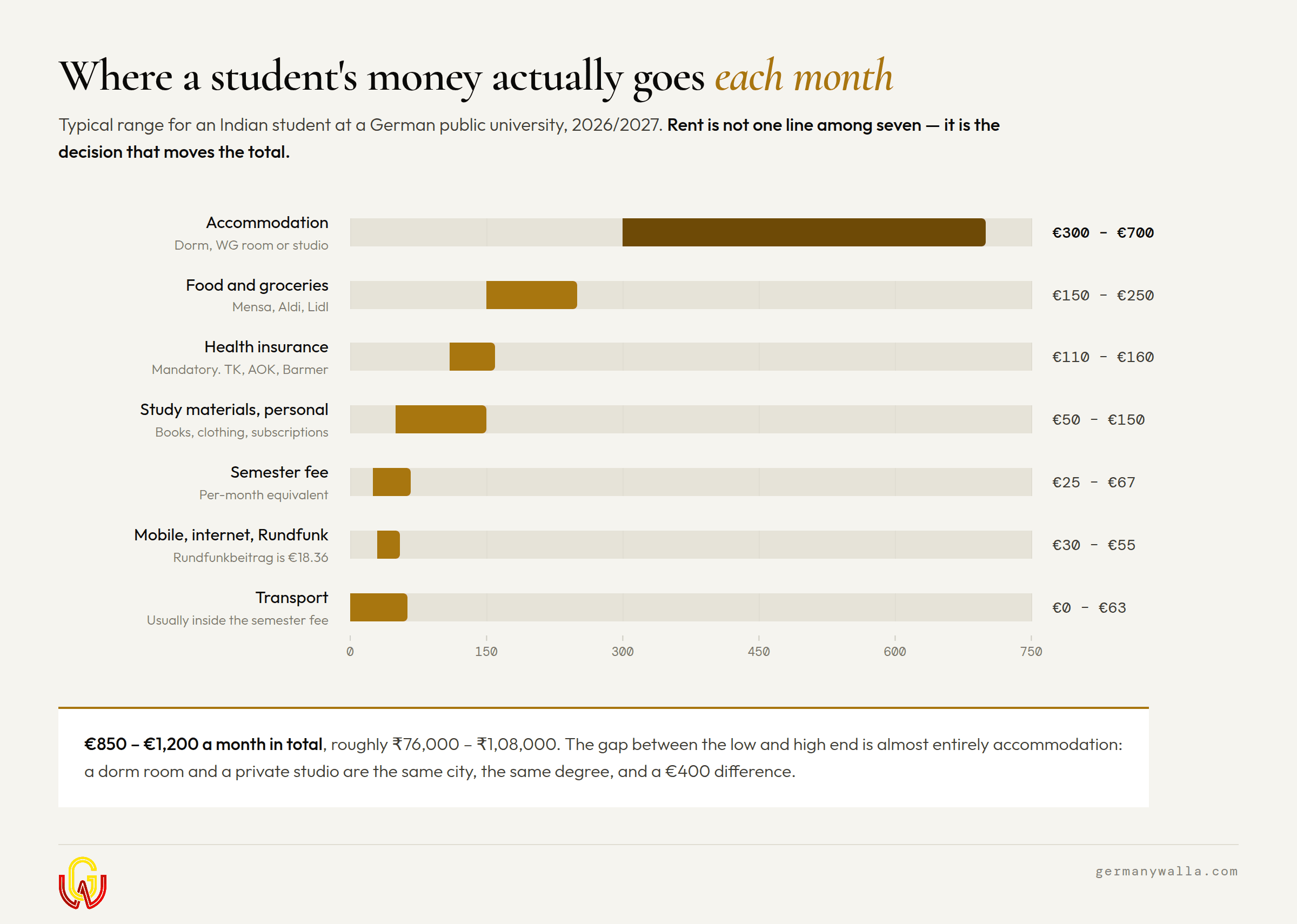
| Expense Category | Monthly Cost (€) | Monthly Cost (₹ approx.) | Notes |
|---|---|---|---|
| Accommodation (Rent) | €300 – €700 | ₹27,000 – ₹63,000 | Student dorm €250–€400; WG room €400–€600; private studio €700–€1,200+ |
| Food & Groceries | €150 – €250 | ₹13,500 – ₹22,500 | Mensa lunch €2.50–€5; Aldi/Lidl shopping; eating out regularly pushes to €600+ |
| Health Insurance | €110 – €160 | ₹9,900 – ₹14,400 | Mandatory for all students. TK, AOK, Barmer are common providers |
| Transportation | €0 – €63 | ₹0 – ₹5,600 | Most unis include Deutschland-Semesterticket in semester fee. Unlimited regional travel. |
| Mobile, Internet & Rundfunkbeitrag | €30 – €55 | ₹2,700 – ₹4,950 | SIM ~€10–15/month; internet in WG shared; Rundfunkbeitrag (mandatory) €18.36/month |
| Study Materials & Personal | €50 – €150 | ₹4,500 – ₹13,500 | Books, stationery, clothing, entertainment, subscriptions |
| Semester Fee (Semesterbeitrag) | €25 – €67/month equivalent | ₹2,250 – ₹6,000 | €150–€400 per semester. Often includes Semesterticket. Paid every 6 months. |
| Total (typical range) | €850 – €1,200 | ₹76,000 – ₹1,08,000 | Lower in eastern cities; higher in Munich and Frankfurt |
Most guides show you the numbers but not where the hidden shocks are. From guiding 1,200+ students: accommodation is always the variable that breaks budgets, not food or transport. A student in a Studentenwerk dorm at €280/month lives comfortably on €850 total. The same student in a private WG at €600/month suddenly needs €1,200+. The choice of accommodation type — not the city — is the biggest financial decision you make before arriving.
Accommodation: Your Biggest Expense — and Your Biggest Decision
Rent is 40–55% of a student's monthly budget in Germany. There are three types of student accommodation, each with a very different cost and availability picture.
1. Studentenwohnheim (Student Dormitory) — Cheapest
Managed by the Studentenwerk (the student services organisation at each university), dormitories are subsidised and offer the cheapest rents in Germany for students. Typical cost: €200–€400/month (₹18,000–₹36,000) including utilities.
The catch: waiting lists of 6–18 months in popular cities. In Munich, Berlin, and Hamburg, you will almost certainly not get a dorm room by the time you arrive for your first semester. Apply the moment you receive your admission letter — not when you arrive in Germany. In smaller cities like Magdeburg, Osnabrück, or Chemnitz, dorm availability is much better and you may get a room by your first semester.
2. WG / Wohngemeinschaft (Shared Apartment) — Most Common
A WG is a shared flat where each tenant has a private room and shares kitchen and bathroom. This is the most common living arrangement for students in Germany. Typical cost: €350–€650/month (₹31,500–₹58,500) depending on city.
WG rooms in Germany are advertised on WG-Gesucht.de — the main platform. Start searching 2–3 months before your arrival. Important terminology: Warmmiete (warm rent) includes heating and basic utilities in the price. Kaltmiete (cold rent) does not — you pay utilities separately, which adds €50–€100/month. Always clarify which one is listed before agreeing.
3. Private Studio / Apartment — Most Expensive
A private studio or one-bedroom apartment gives you full independence but costs €700–€1,200+/month (₹63,000–₹1,08,000+) in most German cities. In Munich and Frankfurt, studios under €900 are rare. This option only makes financial sense if you are sharing a two-bedroom with another student.
⚠️ The dormitory waitlist reality. Every year, students tell me they will "sort out accommodation when they arrive." This is how you end up paying €700/month for a private studio you found in desperation. Apply for a Studentenwerk dorm immediately after you receive your Zulassung (admission letter). Even if you don't get it for semester 1, you move up the list for semester 2.
City-by-City Cost of Living Comparison for Students
Your city choice is the single biggest variable in your monthly budget. The difference between studying in Leipzig vs Munich is roughly €350–€450/month — that is €4,200–€5,400 per year in savings, just from city choice. For Indian students asking "which is the cheapest city to study in Germany" — the answer is consistently the eastern German cities, which combine low cost of living with strong public universities and improving job markets.
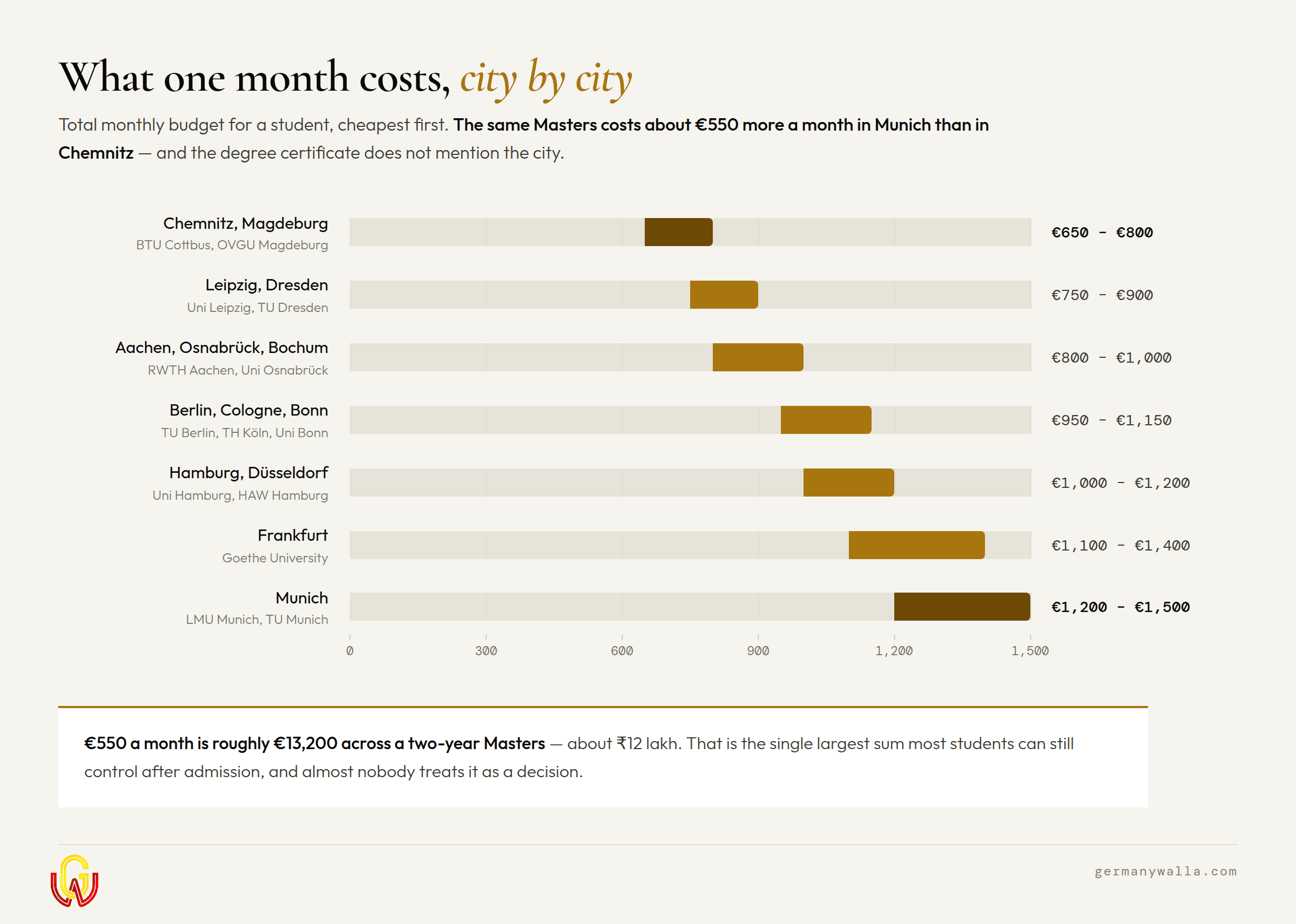
| City | Monthly Budget | Tier | Key Universities |
|---|---|---|---|
| Chemnitz, Magdeburg | €650–€800 | Most Affordable | BTU Cottbus, OVGU Magdeburg |
| Leipzig, Dresden | €750–€900 | Affordable | Uni Leipzig, TU Dresden |
| Aachen, Osnabrück, Bochum | €800–€1,000 | Affordable–Moderate | RWTH Aachen, Uni Osnabrück |
| Berlin, Cologne, Bonn | €950–€1,150 | Moderate | TU Berlin, TH Köln, Uni Bonn |
| Hamburg, Dusseldorf | €1,000–€1,200 | Moderate–High | Uni Hamburg, HAW Hamburg |
| Frankfurt | €1,100–€1,400 | Expensive | Goethe University |
| Munich | €1,200–€1,500 | Most Expensive | LMU Munich, TU Munich |
Food Costs in Germany for Students
Food in Germany is significantly cheaper than in the UK or Scandinavia. As a student, you have three main options:
- Mensa (university canteen) — €2.50 to €5.00 per hot meal. With your student ID, the Mensa is heavily subsidised. A full lunch — main course, side, drink — for under €4 is genuinely standard at most German universities. This is the cheapest daily lunch option available anywhere in Germany.
- Cooking at home — Budget €150–€200/month shopping at discount supermarkets like Aldi, Lidl, Netto, or Penny. Indian cooking staples (lentils, rice, spices) are increasingly available at Asian supermarkets and online. 1kg of lentils costs around €2–€4. Vegetables average €2–€4/kg.
- Eating out / restaurants — A casual restaurant meal runs €10–€20 per person. Frequent dining out will push your food budget to €400–€600+/month. Reserve restaurants for weekends or occasional treats.
Realistic food budget for an Indian student cooking at home and using the Mensa for lunch: €150–€200/month. Students who eat out frequently: €300–€400/month.
Health Insurance: Mandatory and Non-Negotiable
Health insurance is mandatory for enrollment at any German university. You cannot enroll without proof of health insurance coverage. The standard rate for students under 30 on public health insurance (gesetzliche Krankenversicherung) is €110–€160/month (₹9,900–₹14,400).
The most popular public health insurance providers for students are TK (Techniker Krankenkasse), AOK, and Barmer. Coverage includes doctor visits, hospital stays, prescription medications, and basic dental. You can register online before arriving in Germany.
Important: you must register for health insurance before completing university enrollment. The university will ask for your insurance number (Matrikelnummer) and a confirmation from your insurer during the enrollment process. Most providers have English-language online portals and can handle the process before you arrive.
⚠️ Private travel insurance from India is NOT a substitute for German statutory health insurance. Many students try to use their Indian travel insurance to avoid the monthly cost. German universities will not accept this for enrollment. You need to be registered with a German statutory health insurer (like TK or AOK) before you can complete your enrollment.
Transportation: Effectively Free at Most Universities
Transport is where Indian students in Germany have a major advantage they often underestimate. Most German universities now include the Deutschland-Semesterticket in the semester contribution — which gives you unlimited travel on all local buses, trams, S-Bahn, U-Bahn, and regional trains across Germany for the entire semester.
This ticket alone, if purchased individually, would cost €58/month (the Deutschland-Ticket monthly price). Bundled in your semester fee, you effectively get it for free or at a heavily discounted rate.
What this means practically: your daily commute costs zero. Weekend trips to other German cities cost zero. Travel from Osnabrück to Berlin for a weekend? Zero extra cost. This fundamentally changes your transport budget — in most cities, it is €0.
Exceptions: ICE and IC long-distance trains (like Berlin to Munich at high speed) are not covered. Those require separate tickets. For long distance travel use the regional trains (covered) or book ICE tickets early for €19–€29 fares.
One-Time Pre-Departure Costs from India
Before you arrive in Germany, there are several one-time costs to budget for. These are separate from monthly living expenses:
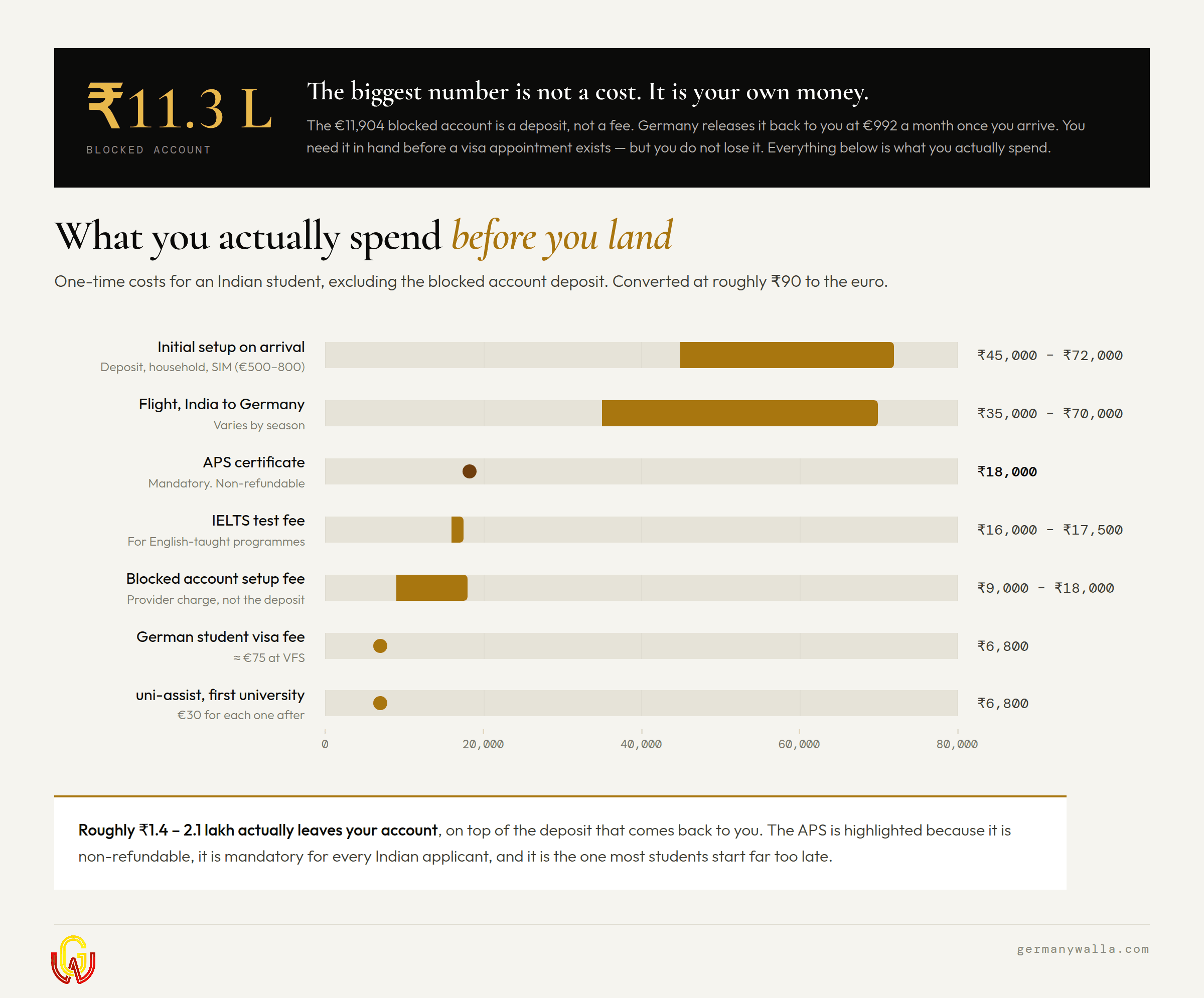
| Cost Item | Amount | Notes |
|---|---|---|
| APS Certificate | ₹18,000 | Mandatory document verification for all Indian students. Non-refundable. See our APS guide. |
| Blocked Account (Sperrkonto) | €11,904 deposit + €100–200 setup | Your own money, returned monthly at €992. Expatrio or Coracle. Required for visa. |
| German Student Visa Fee | ~€75 (≈₹6,800) | Paid at VFS/Embassy appointment. |
| uni-assist Application Fee | €75 first uni + €30 each additional | Required for applications to most German public universities. |
| IELTS Test Fee | ₹16,000–₹17,500 | Required for English-taught programs. See our IELTS guide. |
| Flight (India to Germany) | ₹35,000–₹70,000 | Varies by season. Book early for cheaper fares. |
| Initial setup costs on arrival | €500–€800 | Deposit, household basics, SIM, transport before semester ticket. |
The blocked account is where most families panic — €11,904 is a large sum to deposit upfront. Remember: this is not a fee. It is your own money that Germany releases back to you at €992/month. By the end of your first year, every euro is back in your hands. The setup fee (€100–200) is the only actual cost. Most families fund the blocked account through education loans or family savings accumulated over the application period.
Part-Time Work: How to Offset Living Costs
Indian students on a German student visa are legally permitted to work part-time. As of 2026/2027, the rules are:
- Annual limit: 140 full days or 280 half days per year (increased from 120 full days in 2024)
- During semester: maximum 20 hours per week
- During semester breaks (Semesterferien): full-time work is allowed
- Minimum wage from 1 January 2026: €13.90/hour gross
- Minijob limit: €603/month — earnings below this are tax-free and exempt from most social security contributions
What Do Students Actually Earn?
| Job Type | Hourly Rate | Notes |
|---|---|---|
| HiWi (Student/Research Assistant) | €14–€20+/hour | On-campus at your university. Best flexibility, most relevant for your studies. |
| Tutoring | €15–€35/hour | Private tutoring. Lucrative but requires finding clients. |
| Delivery (Lieferando, etc.) | €13–€16/hour | Flexible hours, popular with students. Tips on top. |
| Hospitality (waiter, barista) | €12–€19/hour | Plus tips, especially in Munich and Frankfurt. |
| Retail / Supermarket | €13–€14.50/hour | Lidl, Aldi, Netto — regular shifts, stable income. |
| Minimum wage baseline | €13.90/hour (from Jan 2026) | Legal minimum for all workers in Germany. |
Working 15–20 hours per week at €13.90–€16/hour, a student realistically earns €700–€1,000/month net — enough to cover a significant portion of monthly living costs. Many Indian students I have guided cover 60–70% of their monthly expenses through part-time work by their second semester.
The HiWi position at your own university is the gold standard for student employment in Germany. It pays the best, the hours are flexible around your class schedule, and it directly strengthens your CV for German industry. Apply for HiWi positions as soon as you arrive — check your university's Stellenwerk portal and speak to your professors in the first month. Most Indian students who struggle financially in Germany never looked for a HiWi position. Most who are comfortable here found one within their first two semesters.
Germany vs UK / Canada / Australia: The Real Cost Comparison
This is the comparison that puts everything in perspective for Indian students and their families.
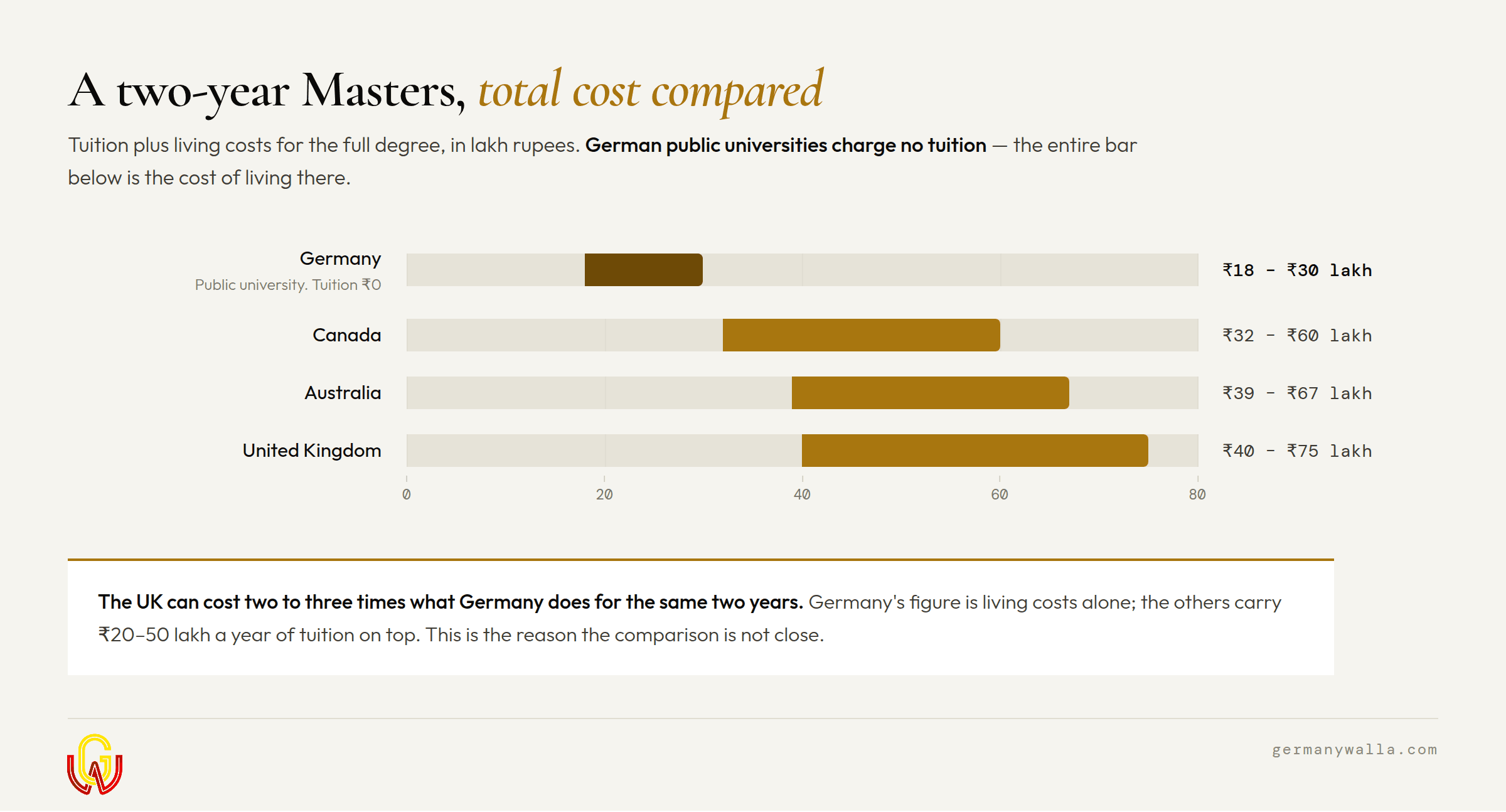
| Country | Annual Tuition | Annual Living Costs | Total 2-Year Masters Cost |
|---|---|---|---|
| Germany (public uni) | ₹0 | ₹9–15 lakh/year | ₹18–30 lakh total |
| UK | ₹25–50 lakh/year | ₹15–25 lakh/year | ₹40–75 lakh total |
| Canada | ₹20–40 lakh/year | ₹12–20 lakh/year | ₹32–60 lakh total |
| Australia | ₹25–45 lakh/year | ₹14–22 lakh/year | ₹39–67 lakh total |
A 2-year Masters in Germany costs ₹18–30 lakh total — almost entirely living expenses. The equivalent in the UK or Canada costs ₹40–75 lakh, with the majority being tuition fees. Germany does not make education free. It removes the largest cost, which changes the entire financial picture for Indian families.
Practical Money-Saving Tips for Indian Students in Germany
- Apply for student dormitory immediately after receiving your Zulassung. Every week you delay is a week lower on the waitlist. Even if you don't get it for semester 1, being on the list for semester 2 saves you months of paying private market rent.
- Use the Mensa every day for lunch. At €2.50–€5 per meal, the Mensa is genuinely the cheapest hot food you will find anywhere in Germany. Students who skip it and eat out daily spend €200–€300 more on food every month.
- Shop at discount supermarkets. Aldi, Lidl, Netto, and Penny are significantly cheaper than Rewe, Edeka, or Kaufland. Most Indian cooking staples are available and affordable. A weekly grocery shop for one person should cost €30–€50.
- Find a HiWi position in your first semester. University student assistant roles pay €14–€20/hour, have flexible hours, and look excellent on a German CV. Check your university's Stellenwerk portal and email professors directly.
- Use your Semesterticket actively. It covers unlimited regional travel across Germany. Weekend trips, visiting friends in other cities, travel during semester breaks — all covered at zero extra cost. If you are not using it, you are leaving money on the table.
- Share the Rundfunkbeitrag with flatmates. €18.36/month is per household, not per person. In a 3-person WG, each pays €6.12/month instead of €18.36. Only one person needs to register for the household.
- Cook Indian food at home. Asian supermarkets (Asia Supermarkt, Rewe's international section) stock Indian staples. Cooking a proper Indian meal at home costs €2–€5 per serving versus €15–€25 at an Indian restaurant.
Is 20 Lakhs Enough to Study in Germany? Is €2,000 Enough to Live On?
These are the two most commonly searched questions on this topic — so let's answer them directly.
Is 20 lakhs (₹20,00,000) enough to study in Germany?
Yes — ₹20 lakh is enough for approximately one full year of studying in Germany including all living expenses, if you study in a mid-range to affordable city. Breaking it down: the blocked account requirement is €11,904 (≈₹10.7 lakh), which is released to you monthly and covers your living costs. The remaining ₹9–10 lakh covers your one-time pre-departure costs (APS ₹18,000, IELTS ₹17,000, visa ₹6,800, flights ₹40,000–70,000), initial setup costs on arrival, and a financial buffer.
For a 2-year Masters, budget ₹25–35 lakh total depending on city, accommodation, and lifestyle. The blocked account covers year 1 living expenses. Part-time work income and family support cover year 2. Students in affordable eastern cities living in dormitories can complete a 2-year Masters for as little as ₹20–22 lakh all-in.
Is €2,000/month enough to live in Germany as a student?
Yes — €2,000/month is very comfortable for a student in Germany. Even in Munich, which is the most expensive city, the average student budget is €1,200–€1,500/month. With €2,000/month you can live comfortably in any German city, afford a private studio if you prefer, eat out occasionally, and still save. Most students manage on €850–€1,200/month.
Frequently Asked Questions
€850–€1,200/month for a world-class German university education — zero tuition on top. That is the honest number. Choose your city wisely, secure your accommodation early, use the Mensa, get a HiWi position, and the finances work. Every one of the 1,200+ students I have guided to Germany has made it work.
If you want your full financial plan built accurately — city choice, budget breakdown, university shortlist, SoSe 2027 timeline — book a Clarity Call. 30 minutes. ₹1,699, adjusted on enrolment.