The Germany student visa process for Indian students is the last step in a long chain, and the one most likely to cost you an intake. By the time most Indian students reach the visa stage, they have already done the hard intellectual work. The shortlist is built, the admission letter is in hand, the APS certificate is done, the blocked account is funded. What remains looks administrative.
It is not. The visa stage is where the largest number of otherwise well-prepared Indian students lose an intake — not because they were ineligible, but because they misread a requirement, booked the wrong mission, or started six weeks before a process that routinely takes several months.
This guide covers the Germany student visa process from your admission letter to the visa decision. It deliberately stops there — what happens after you land is a genuinely different subject with its own steps, and we cover it separately.
Germany Student Visa for Indian Students: What It Actually Is
If you are going to Germany to study for longer than 90 days — which every degree programme is — you need a national visa, category D, not a Schengen visa. The German Missions in India put it plainly: "If you wish to stay in Germany for more than 90 days, please apply for a German National visa."
The national visa is your entry document. It is typically issued for an initial period, and after you arrive you convert it into a residence permit for study purposes. That conversion happens in Germany and is outside the scope of this guide.
The application questionnaire in the portal will determine which sub-category applies to you, and the admission document you need differs accordingly. The official page identifies three distinct scenarios:
- An admission letter to a preparatory college (Studienkolleg)
- Your letter of admission from a full-time degree programme in presence at a German university
- A confirmation of registration for a language course
⚠️ Note the phrase "full-time degree programme in presence." The visa route described here is for on-campus, full-time study. Distance, online or part-time programmes are not what this visa is for. If your programme is anything other than full-time and in person, confirm with your mission before you build a plan around it.
What Must Already Be True Before You Apply for the Germany Student Visa
The visa application is the last step in a chain, not the first. Five things need to exist before you begin, and each takes weeks or months of its own.
Inside the Germany Student Visa Process: The Consular Services Portal (CSP)
This is the biggest change to the process and the part most older guides get wrong. Germany has moved national visa applications onto an online portal, and for India the position is stated unambiguously by the missions:
"If a visa application is possible online through the Consular Service Portal (CSP), it is obligatory to do it through the CSP."
The portal sits at digital.diplo.de. You create an account, complete the application there, and upload your documents digitally before any in-person appointment exists. The mission's own description of the flow is five steps:
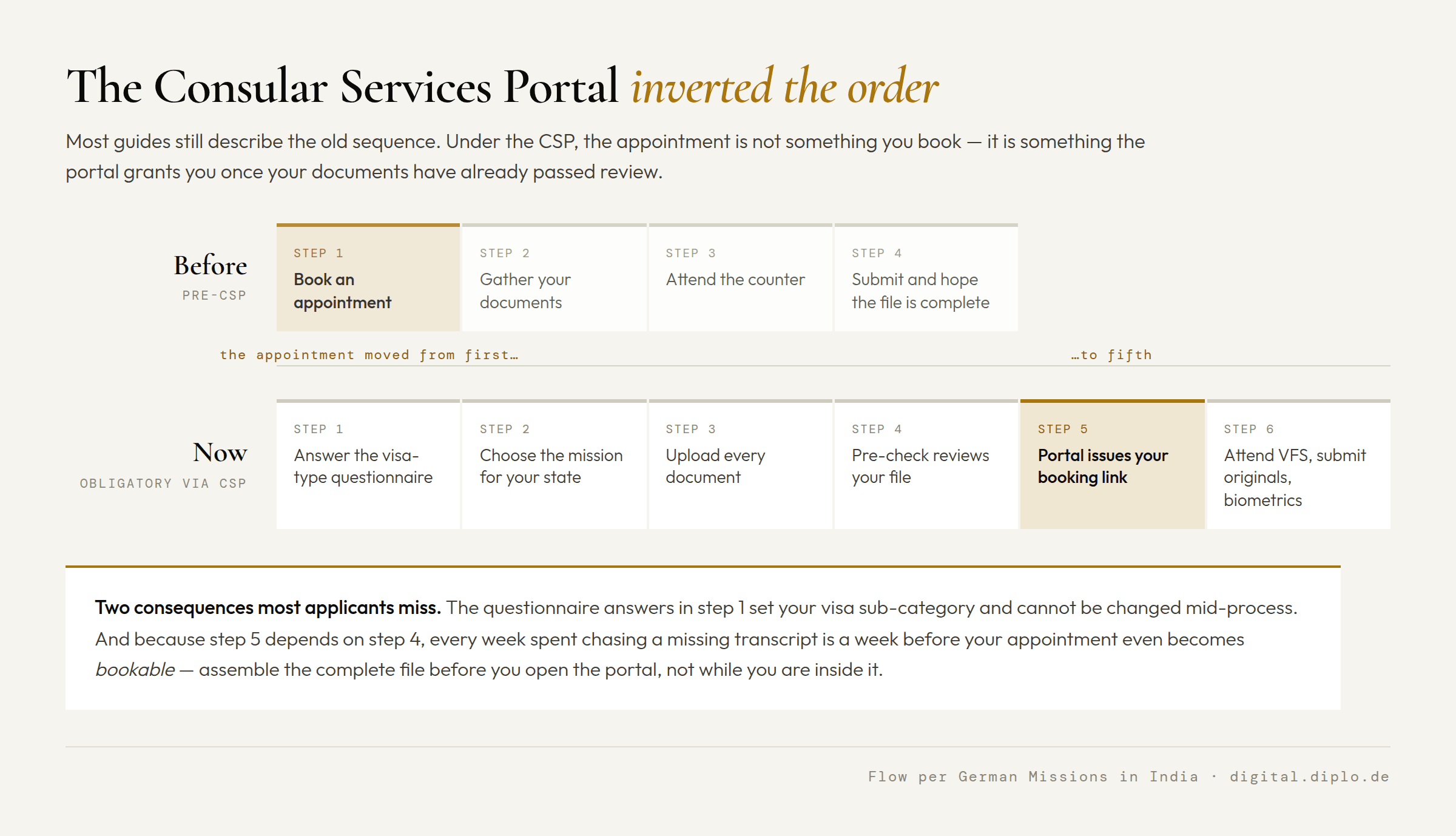
The sequencing here is the thing to internalise, because it inverts what students expect. Under the old system you booked an appointment first and worried about documents later. Under the CSP your documents come first, and the appointment is something the portal grants you once the file is in order. Every week you spend chasing a missing transcript is a week before your appointment even becomes bookable. Assemble the complete file before you open the portal, not while you are inside it.
Which German Mission Handles Your Germany Student Visa Application?
Consular jurisdiction is determined by your place of residence in India, and applying to the wrong mission wastes an appointment. These are the jurisdictions as published by the German Missions in India:
| Mission | States and Union Territories Covered |
|---|---|
| German Embassy New Delhi | Haryana, Himachal Pradesh, Punjab, Rajasthan, Sikkim, Uttar Pradesh, Uttarakhand, and the Union Territories of Chandigarh, Delhi, Jammu and Kashmir, Ladakh, Andaman and Nicobar Islands, Lakshadweep, Minicoy and Amindivi |
| Consulate General Mumbai | Maharashtra, Chhattisgarh, Gujarat, Goa, Madhya Pradesh, and the Union Territories of Daman and Diu and Dadra and Nagar Haveli |
| Consulate General Chennai | Tamil Nadu, Andhra Pradesh, Telangana, and the Union Territory of Puducherry |
| Consulate General Bengaluru | Karnataka and Kerala |
| Consulate General Kolkata | West Bengal, Bihar, Jharkhand, Odisha, Assam, Arunachal Pradesh, Manipur, Meghalaya, Mizoram, Nagaland and Tripura |
* Jurisdictions as listed by the German Missions in India. Confirm on the official addresses page before applying, as they can be revised.
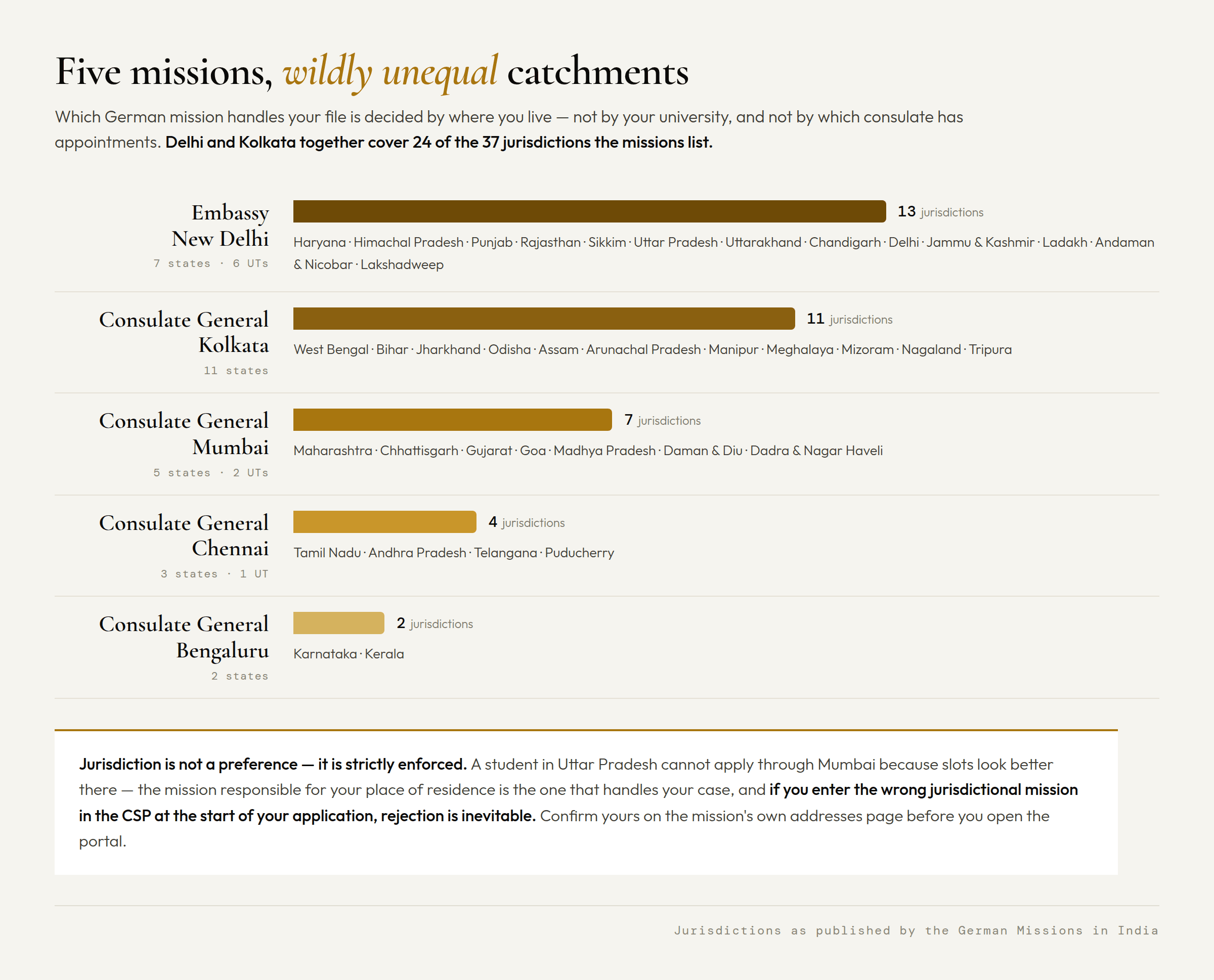
⚠️ Strictly no: you cannot apply anywhere outside the embassy or consulate that oversees your jurisdiction. Students in Uttar Pradesh sometimes try to apply through Mumbai because slots look better there. It does not work. And in the CSP, if you give wrong information about the jurisdictional consulate or embassy handling your file at the start of your application, your visa rejection is inevitable.
Germany Student Visa Document Checklist for Indian Students
The documents required for upload, as listed by the German Missions in India for study visas:
| Document | What exactly is required |
|---|---|
| Passport | Valid, issued within the last 10 years, with at least 2 blank pages. Upload the photo and personal details page. |
| Academic certificates | For Bachelor's applicants: Class 10 and Class 12 mark sheets and school leaving certificate. For Master's or PhD applicants: your previous degree plus semester mark sheets. |
| Language certificate | The same certificate you used to secure your admission — IELTS for English-taught programmes, or B2–C1 / TestDaF for German-taught ones — and it must still be valid. See the language section. |
| APS certificate | Required unless you fall under a listed exemption. If exempt, Anabin or ZAB recognition of your qualification may be required instead. |
| Admission letter | From your German university, preparatory college, or language course — matching your visa sub-category. |
| Motivation letter | In English or German, explaining your choice of study and your plans after graduation. |
| CV | In tabular format, in English or German. |
| Proof of financial means | Blocked account confirmation or scholarship award. Even with an education loan, a blocked account confirmation is mandatory — loan sanction letters are not accepted on their own. |
| Fee payment proof | For private universities and language courses: the fee invoice plus proof of payment or deposit. |
| Health insurance | Certificate covering you from your date of arrival. |
| Optional | Previous long-term visas or German residence permits, if you have held any. |
⚠️ Two sentences from the official page that students should take seriously. First, the missions "reserve the right to request additional documents" — and further fees may apply if they do. Second, incomplete documentation, or refusing to attend the interview, results in rejection. There is no partial credit here.
Always cross-check this list against the official study visa page on the day you apply. Requirements are revised, and the mission's own page is the only version that governs your application.
The Germany Student Visa Language Requirement
This is the part of the Germany student visa process that Indian applicants over-think most, and the answer is simpler than the internet suggests. The principle is the same whether your programme is taught in English or in German: the university sets the level, and the mission accepts it.
The embassy does not ask for separate language requirements from what your university required. Whatever English language certificate you used to get your university admission — IELTS, in most cases — you simply provide the same certificate for the visa process.
There is no second, higher bar waiting for you at the mission. There is, however, one condition attached to the first one, and it is the condition that catches people out.
What if my programme is taught in German?
The same principle applies — the university sets the requirement, you satisfy it to get admission, and the mission accepts the same certificate. The difference is where that bar sits. For German-taught Bachelor's and Master's programmes, expect a minimum of B2 to C1, or a TestDaF certificate. Which of those your programme asks for is decided by the university, not by the mission, so read your own admission requirements rather than a general figure.
Your certificate must still be valid
You must make sure your language certificate is still valid throughout the duration of your visa application process. Not valid on the day you applied to the university. Valid on the day you upload it, and valid while your file sits with the mission.
What happens if your IELTS was valid during university admission but has expired by the visa stage?
Do not use it. If you submit an expired IELTS — or any expired language certificate — your Germany student visa will inevitably be rejected. If your score expires before your visa application is submitted, you must retake the exam and provide a valid certificate to the embassy.
This is the quiet failure in a long timeline. A student who tested early, applied across two intakes, and then waited out a processing queue can reach the visa stage holding a certificate that lapsed months ago — with an admission letter that was perfectly valid when it was issued.
Which language tests are not recognised for a Germany student visa from India?
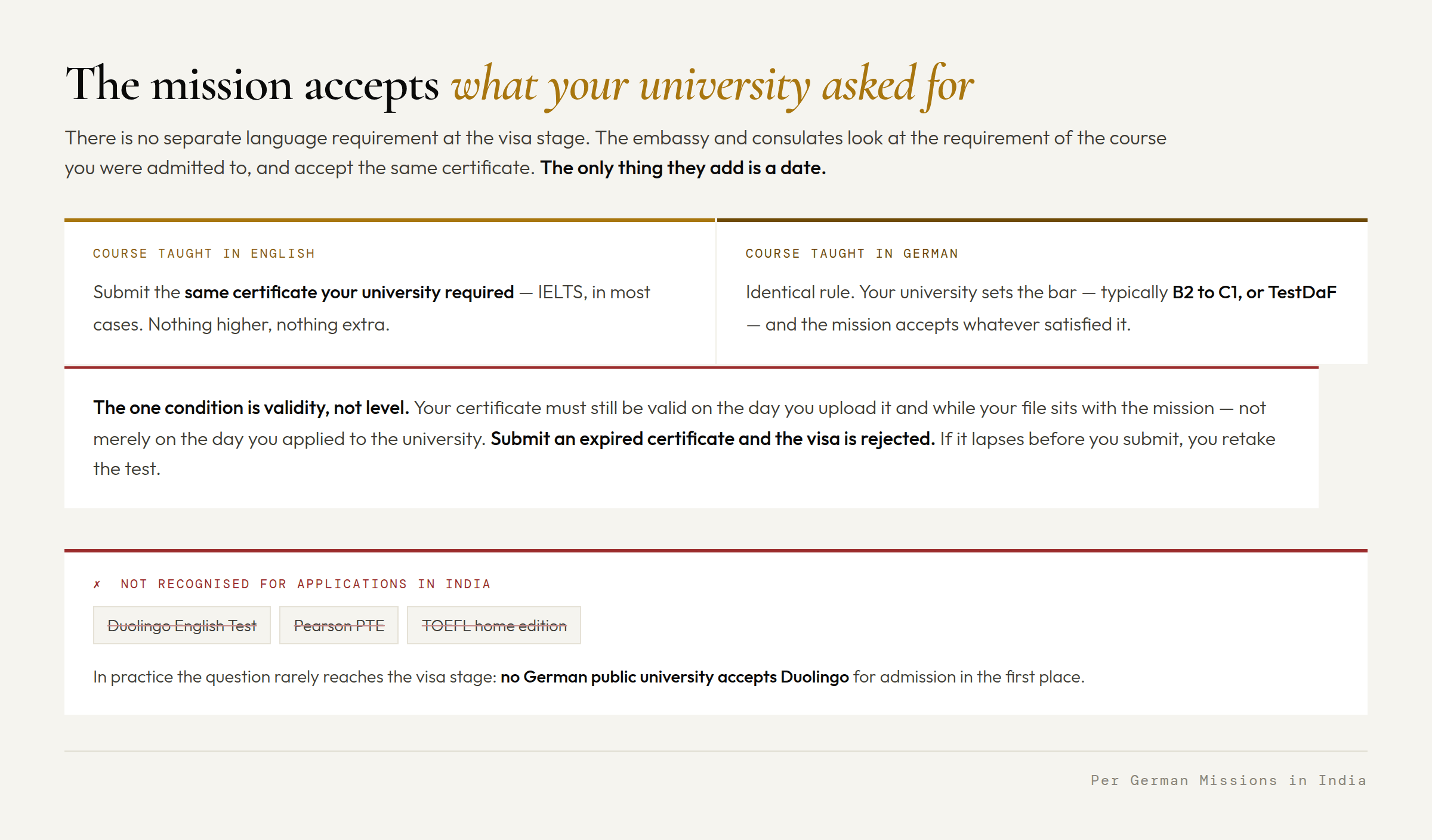
There is no conflict between those two boxes, and students sometimes think there is. The mission does not set its own level — it accepts what your university accepted. The reason Duolingo never becomes a problem at the visa stage is that it does not get you into a German public university in the first place.
So the thing to watch is the date, not the score. Your admission letter has already settled what level you need and which test proves it. All that remains is making sure the certificate is still valid on the day the mission looks at your file.
Booking Your Germany Student Visa Appointment at VFS Global
Once your CSP pre-check clears, you book the in-person appointment. One thing has changed here that most older guides still get wrong.
100% of German student visa appointments are now held through VFS Global centres connected to your specific consulate or embassy — VFS Mumbai handles the Mumbai consulate jurisdiction, and so on for each mission. Student visa appointments are no longer held directly at the consulates or the embassy.
Booking runs through the VFS Global website at visa.vfsglobal.com, using the link your mission’s own page points to.
What if every appointment slot is already booked?
You keep checking. There is no waitlist any more. VFS does not add you to a queue and does not email you when slots open, the way it used to. You have to check the VFS portal again and again until slots appear.
Plan around that rather than resenting it. Slots are released in batches, they go quickly, and the students who get them are the ones checking daily — not the ones waiting for a notification that is never coming.
⚠️ Be extremely careful with agents promising guaranteed or faster appointment slots. Appointments are allocated through the official systems described above. Anyone offering to sell you a slot outside those systems is, at best, taking money for something they do not control. Book through the official VFS Global portal linked from your own mission’s page, and nowhere else.
Germany Student Visa Fee for Indian Students
As published by the German Missions in India for national visas:
| Applicant | Fee |
|---|---|
| Aged 18 and over | €75 — around ₹8,100 |
| Under 18 | €37.50 — around ₹4,100 |
The fee is payable in Indian rupees at the exchange rate applicable on the day of your on-site appointment, so the rupee figure moves. Carry a little more than the published amount.
The visa fee is not returned if your application is refused. You are paying for the processing of your application, not for its approval. This is stated plainly by the missions and it is worth absorbing before you apply — it is one of several reasons to submit a complete, accurate file the first time.
Note that VFS may charge its own service fee separately from the visa fee. Check the current schedule on the VFS portal when you book.
Is There an Interview for the Germany Student Visa?
You attend your VFS appointment in person, submit your originals, and give biometrics. There is no standard in-person visa interview at the VFS counter.
That is not quite the whole picture. The embassy or consulate can always call you later for a phone interview, or call you directly to the embassy or consulate for an in-person interview. The odds of this happening are currently low — about 2 in 10 cases.
If you are called, it is not an exam. It is a check that you are a genuine student who understands what they have applied for. Expect to be able to speak clearly about:
- Your programme — its name, its content, its duration, and why that specific one
- Your university — where it is, and why you chose it over alternatives
- Why Germany — a reason more specific than "free education"
- Your funding — where the money came from and how you will live on €992 a month
- Your background — how your previous degree connects to this programme
- Your plans afterwards — what you intend to do with the qualification
Answer honestly and consistently with what is in your file. Contradictions between your motivation letter and your spoken answers are the thing that damages an application. And note again: refusing to attend an interview if called results in rejection.
Germany Student Visa Processing Time: How Long It Really Takes
Here the official guidance is honest and slightly uncomfortable. The German Missions in India state that "depending on the category of your national visa application, processing may take several months." No fixed timeframe is published for student visas.
Two further points from the official FAQs, both of which shape how you should plan:
- Status inquiries will not be answered within the first three months after filing. Emailing the mission in week six achieves nothing.
- You will be notified automatically once a decision has been made. There is no need to chase, and chasing does not accelerate anything.
Early appointments are not available on request. The guidance indicates that early appointments can only be granted in extreme medical or humanitarian situations, with supporting documentation. A semester start date is not such a situation.
Take "several months" literally and build your timeline backwards from it. The students who make their intake are the ones who had APS, language certificate and blocked account ready months before the admission letter arrived — so that on the day the offer landed, the CSP application went in that week. The students who miss are rarely the weaker candidates. They are the ones who treated the visa as the last item on a list rather than the longest item on it. Everything upstream of the visa exists to be finished early, precisely so the visa can start early.
What to Do If Your Germany Student Visa Is Refused
Refusals happen, including to well-prepared applicants. The official position sets out two routes:
If you are refused, read the reason given carefully before doing anything else. Most refusals of Indian student visas trace back to something specific and fixable — an incomplete file, insufficient financial proof, an expired language certificate, or doubts about the coherence of the study plan. Reapplying without addressing the stated reason tends to produce the same outcome.
10 Germany Student Visa Mistakes That Cost Indian Students an Intake
- Starting the visa process after the admission letter. APS, language certificate and blocked account should all pre-date your offer wherever possible.
- Submitting an expired language certificate. Even if it was valid during university admission, an invalid certificate at the visa stage leads to rejection.
- Taking a test that gets you nowhere. No German public university accepts Duolingo, and Duolingo, Pearson PTE and TOEFL home edition are not recognised for visa applications in India either.
- Applying to the wrong mission. Jurisdiction follows your place of residence. Applying outside your jurisdiction leads to inevitable rejection.
- Rushing the CSP questionnaire. Answers determine your visa sub-category and cannot be changed mid-process.
- Uploading unclear scans. The pre-check is a real filter; illegible documents stall your file before you reach an appointment.
- Health insurance starting from enrolment instead of arrival. The checklist requires cover from your date of arrival.
- Paying an agent for a "guaranteed" appointment slot. Appointments come through the official systems only.
- Chasing status in the first three months. Inquiries are not answered in that window and you will be notified automatically.
- Failing a phone or in-person interview if called. Your spoken answers and your motivation letter must tell the same story.
Germany Student Visa Process Timeline: Working Backwards From Your Semester
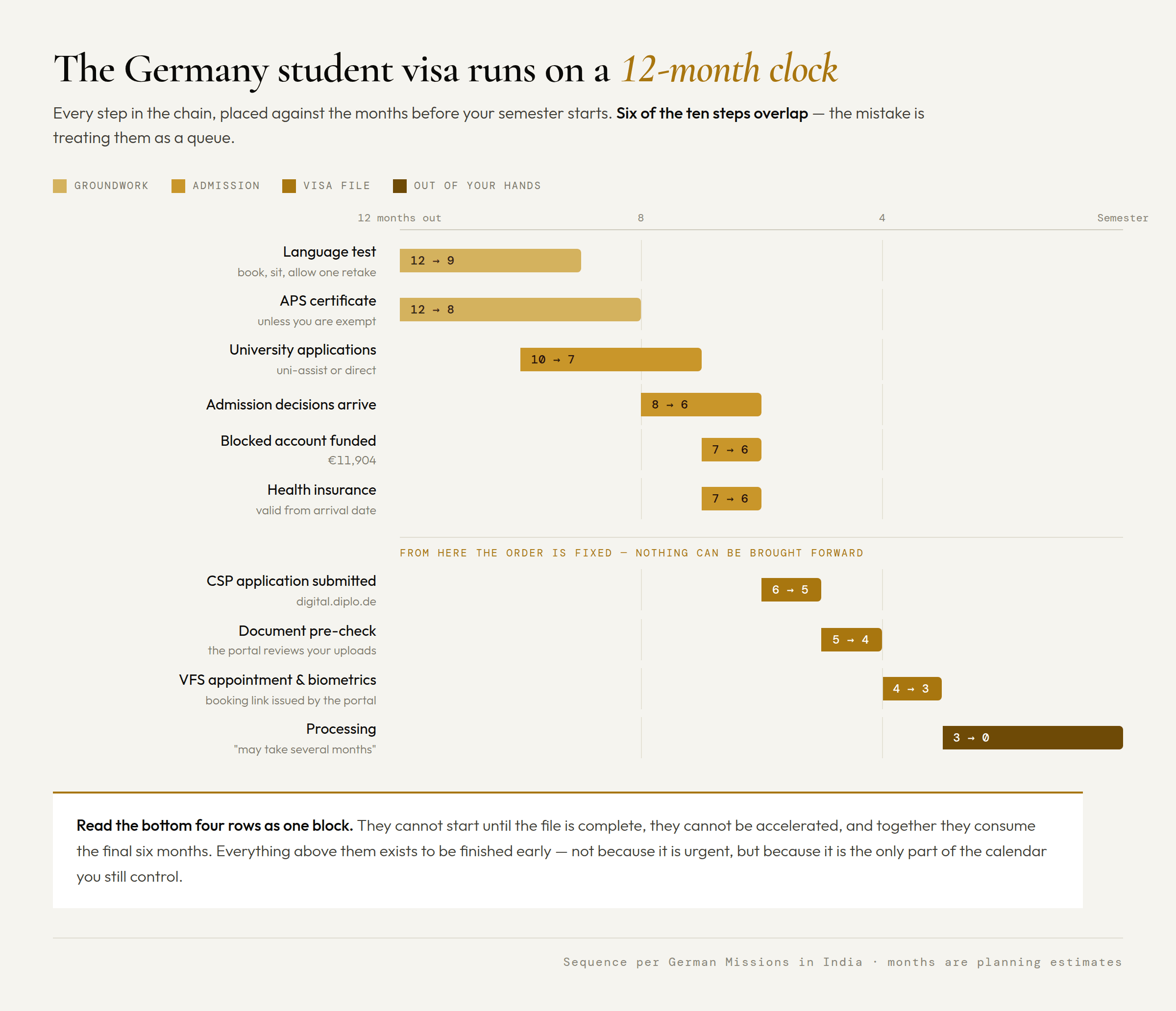
Given that processing may take several months, this is the schedule that actually works:
| When | What must be done |
|---|---|
| 12–10 months before | Check your qualification's recognition status. Book and clear your language test at the required level. Begin APS. |
| 10–8 months before | APS certificate in hand. University applications submitted, directly or through uni-assist. |
| 8–6 months before | Admission decisions arrive. Open and fund the blocked account. Arrange health insurance covering your arrival date. |
| 6–5 months before | Assemble the complete document file. Create your CSP account and submit the application. |
| 5–4 months before | Pre-check clears. Book the appointment via the link the portal issues. If no slots are showing, keep checking the VFS portal daily until they are. |
| 4–3 months before | Attend the appointment, submit originals, give biometrics, pay the fee. |
| 3–0 months before | Processing. Do not chase in the first three months. You are notified automatically when decided. |
Frequently Asked Questions — Germany Student Visa for Indian Students
Everything in this guide comes from the official German Missions in India pages, and every one of those pages is linked above. Read them yourself before you apply. Requirements change, jurisdictions are revised, and the mission's own page is the only version that governs your application.