Every student who decides on Germany arrives at the same screen within a week. A search box, a country full of universities they have never heard of, and a sinking feeling that they are about to make a very large decision using a Reddit thread and a YouTube video titled "Top 10 Universities in Germany."
The instinct is to reach for a ranking. It is the wrong instinct, and in Germany it is wrong in a specific, structural way that this guide will explain. Germany does not organise its higher education system around prestige hierarchies, and if you try to shortlist German universities as if it does, you end up with a list that is simultaneously too ambitious, too narrow, and pointed at the wrong things.
What works instead is a framework. This guide gives you the 3-Tier system — Ambition, Match and Safety — along with the hard filters you apply before the tiers, why German universities are genuinely flatter in quality than students expect, how Universität and Fachhochschule differ, where private universities fit, and the argument I make to every student I work with: choose the course, not the city, and not the university.
Before You Shortlist: Choose the Course, Not the City
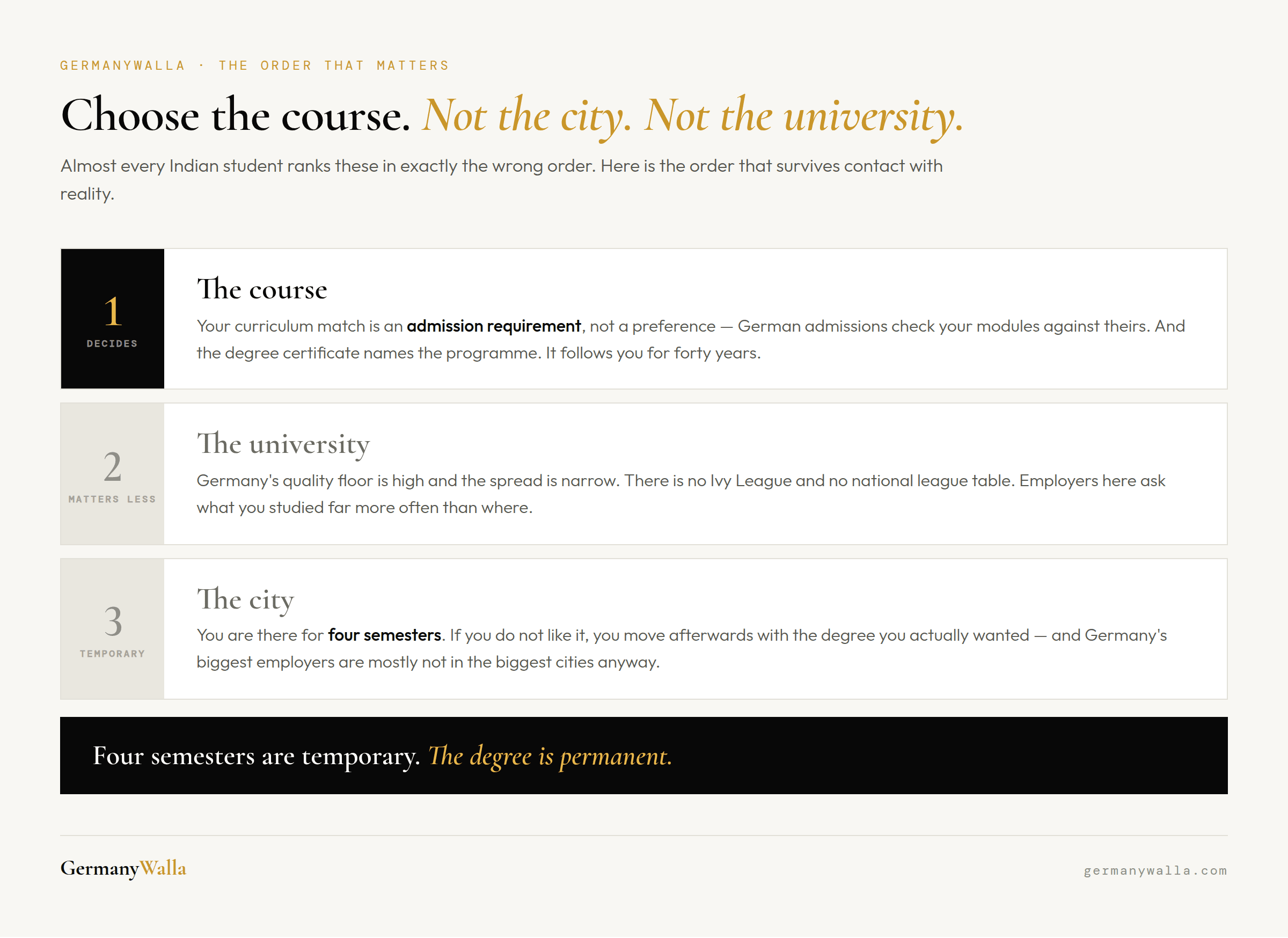
This is the advice I give every single student, and it is the one they push back on hardest — usually because a cousin in Berlin has been enthusiastic, or because a university name sounded impressive when they said it out loud at a family dinner.
So let me make the argument properly, because it is not a soft preference. It is the highest-leverage decision in the entire process.
The Curriculum Is Not a Preference — It Is an Admission Requirement
Start with the part most students discover too late. German Master's admission is substantially decided by curriculum matching. Admissions offices compare your Bachelor's transcript against the programme's required subject areas, module by module, checking whether you have sufficient credits in the specific foundations that programme assumes.
A candidate with a strong grade and a mismatched curriculum is rejected. A candidate with a modest grade and a precisely matching curriculum is admitted. This is not a tiebreaker — for a large share of rejections it is the reason. Students who shortlist by city or by university name routinely apply to eight programmes for which they were never eligible, and read the rejections as "my grade wasn't good enough."
⚠️ Before a programme goes on your shortlist, open its module handbook and its admission requirements and check your own transcript against them. Not the university homepage — the programme's own requirement page, which usually names the subject areas and sometimes the minimum ECTS in each. If you cannot demonstrate the overlap, the programme does not belong on your list, no matter how much you like the city.
The Certificate Names the Programme. It Does Not Name the City.
Your degree certificate will state your degree, your specialisation and your institution. It will never mention that Munich has better weather, that Berlin has a better nightlife, or that your friend from school was two U-Bahn stops away.
What follows you into every interview for the next thirty years is what you studied — the specialisation, the modules, the thesis. A recruiter hiring for embedded systems looks for embedded systems. They do not look for "was in a nice city while studying something adjacent."
You Are There for Four Semesters. Then You Can Move.
Here is the reframe that usually lands. A German Master's is typically four semesters. A Bachelor's is six. If you dislike the city, you leave when you graduate — with the degree you actually wanted. If you chose the city and compromised on the course, you leave with a degree you did not want, and that one is permanent.
Germany makes this asymmetry unusually favourable, because internal mobility is genuinely easy. The labour market is national. Your degree is recognised identically in all sixteen states. There is no regional licensing barrier for most professions. Moving from Magdeburg to Munich after graduation is an apartment search, not a career reset.
And Germany's Industry Is Not in the Big Cities Anyway
The assumption underneath "I want a big city" is that jobs are in big cities. In Germany, that assumption is simply false — and it is the single most useful fact in this article for anyone optimising for career outcomes.
German industry is radically decentralised. Some of the largest employers in Europe are headquartered in towns most international students have never heard of:
- Volkswagen — Wolfsburg, population around 125,000
- Audi — Ingolstadt
- SAP — Walldorf, a town of roughly 15,000 people
- BASF — Ludwigshafen
- Bayer — Leverkusen
- Adidas and Puma — Herzogenaurach
- Bosch — Gerlingen, near Stuttgart
- Siemens Healthineers — Erlangen
- Continental — Hanover
- ZEISS — Oberkochen, population around 8,000
Studying at a well-regarded technical university or FH in a mid-sized city frequently puts you closer to relevant employers than studying in Berlin, which is strong on startups and public sector and comparatively thin on the industrial engineering roles most Indian students are targeting. It is also dramatically cheaper — small-city rent can be half of Munich's, and that difference compounds across four semesters.
I have watched this play out for years now, and the pattern is depressingly consistent. Students who chose the city are the ones who transfer, extend, or quietly regret it. Students who chose the course finish on time and get hired. The city is a two-to-three year inconvenience at worst. The course is your career. If a programme in Chemnitz teaches exactly what you want and a programme in Munich teaches something adjacent, take Chemnitz — and move to Munich afterwards with the right degree in your hand. You will get the city eventually. You only get the degree once.
The Legitimate Exceptions
Intellectual honesty demands the caveats, because location is not always noise:
- Language reality. Larger and more international cities have more English-tolerant part-time work and services, which matters if you are arriving at A2 German. See our guide to part-time jobs and the B1/B2 threshold.
- Genuine industry clusters. If your field really is concentrated — automotive in Baden-Württemberg and Bavaria, chemicals along the Rhine, maritime in the north, startups in Berlin — proximity has value for internships and working-student roles.
- Family or support networks. A real support system in one city is a legitimate factor, especially for a first move abroad.
- Cost. Munich, Frankfurt, Hamburg and Stuttgart are meaningfully more expensive. Our cost of living breakdown has the city-by-city numbers.
Use these as tiebreakers between programmes that already fit. That is their correct weight. What they are not is a first filter.
Step 1: Search Programmes on DAAD and Hochschulkompass
Before you look at a single university name, define what you're actually searching for — then search for the programme, not the institution.
Step 2: Decide Between a Universität and a Fachhochschule
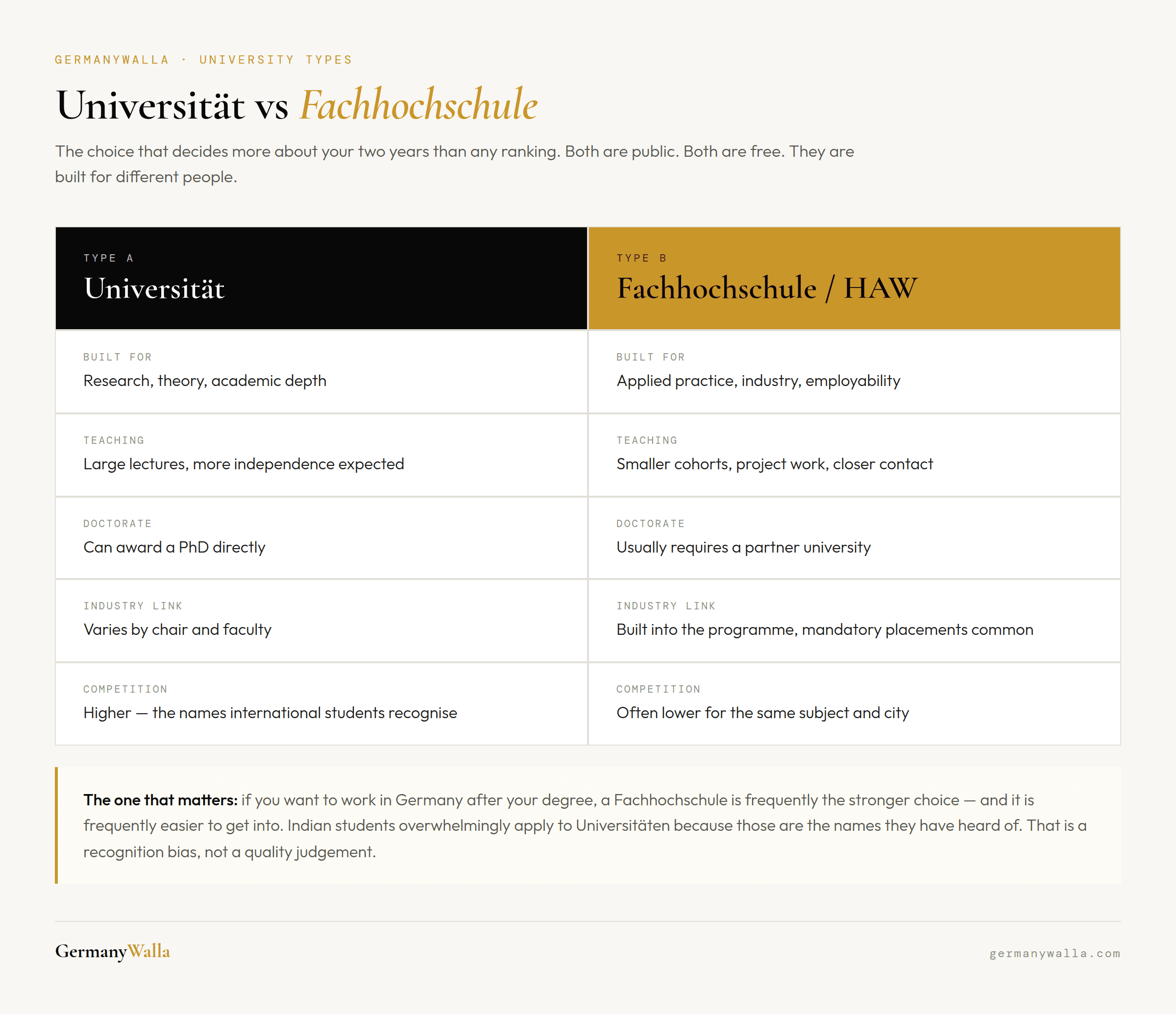
This distinction does more real work in your outcome than any ranking, and most international applicants have never had it explained. Germany has 120 universities, 245 universities of applied sciences and 57 colleges of art and music.
| Universität / TU | Fachhochschule / HAW / University of Applied Sciences | |
|---|---|---|
| Orientation | Theory, scientific method, basic research | Applied practice, industry problems |
| Class size | Large lectures, more independence expected | Smaller groups, more contact with teaching staff |
| Teaching staff | Academic research careers | Professors typically required to have several years of professional experience outside academia |
| Industry links | Varies by chair and faculty | Structural — built into programmes and projects |
| Practical semester | Uncommon | Frequently built into the curriculum |
| Doctorate | Awards doctorates directly | Master's qualifies you to apply, but the doctorate is normally awarded by a university |
| Degree status | Legally equivalent. A Bachelor's or Master's from either is the same qualification level under the Bologna framework. | |
The practical guidance is unglamorous and reliable:
Because world rankings ignore them, universities of applied sciences are systematically under-applied-to by international students — which makes them less competitive at exactly the moment when competition is the thing hurting you. An FH with strong regional industry ties, a mandatory practical semester and an admission process you can actually satisfy is frequently a better outcome than a famous university where you are one of 3,000 applicants for 60 places. Put at least two on your shortlist.
Step 3: Build Your Eligibility Matrix
Before you tier anything, build an eligibility matrix: run every programme on your longlist through these four gates. They are binary — a programme that fails any of them does not belong on any tier, no matter how much you like it.
⚠️ Baden-Württemberg is the only state charging tuition to non-EU students — €1,500 per semester, so €6,000 across a four-semester Master's. That covers Heidelberg, KIT, Freiburg, Stuttgart, Konstanz, Tübingen and Mannheim among others. Several exemptions exist, including for students who already hold a German permanent residence permit and certain scholarship holders. Do not let it eliminate a great programme — but do budget for it deliberately rather than discovering it at enrolment.
Step 4: Tier Your Shortlist into Ambition, Match and Safety
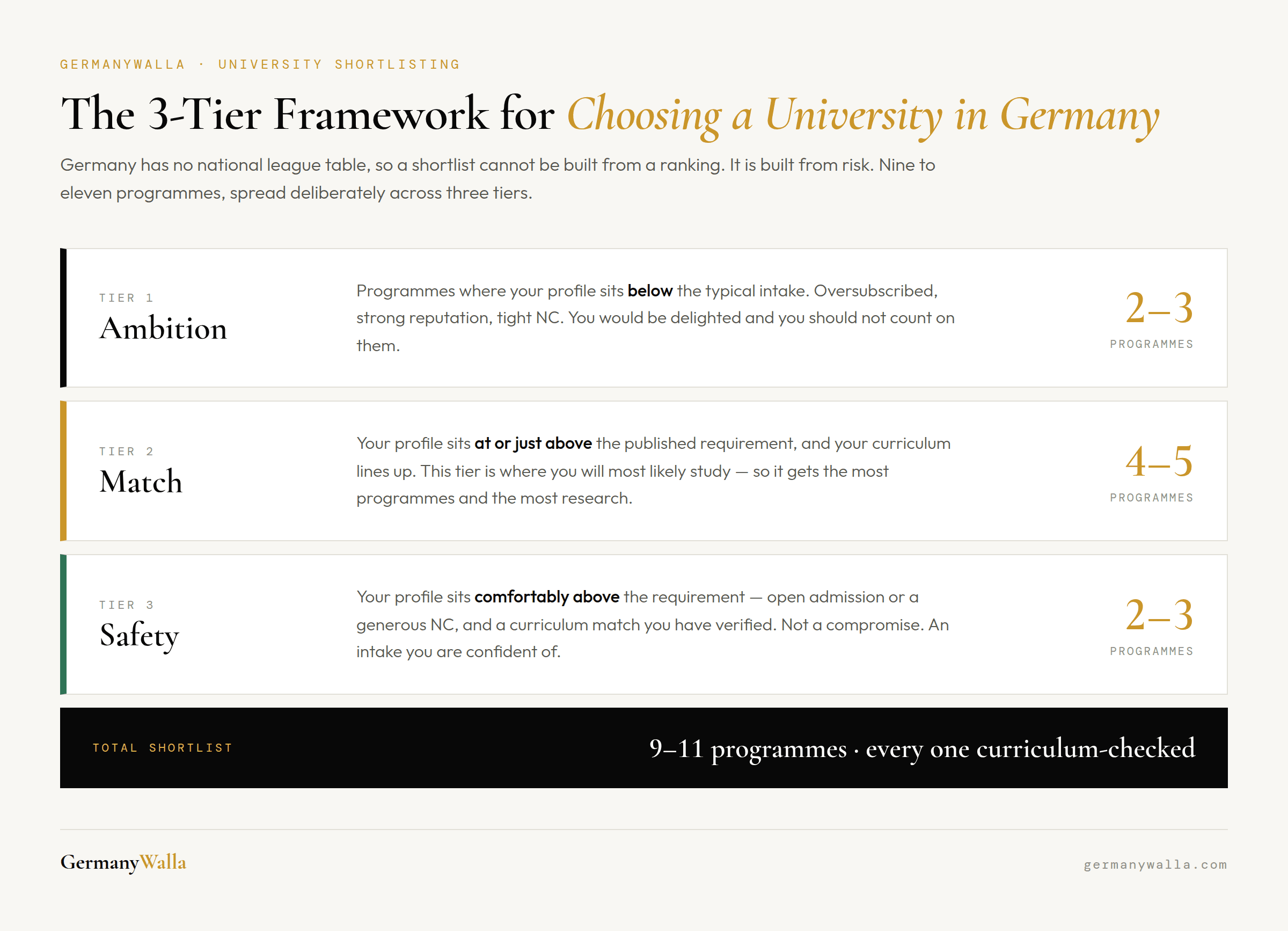
Once your filtered pool exists, sort it into three tiers by how your profile compares to the programme's stated and observed requirements. The goal is a portfolio, not a wish list — designed so that you are very likely to receive at least one offer you are genuinely happy to accept.
| Tier | What it means | How many | Realistic odds |
|---|---|---|---|
| Tier 1 — Ambition | Your profile sits below the typical admitted profile. Competitive programmes, well-known institutions, high applicant volumes. | 2–3 | Low — apply anyway; the cost is a form |
| Tier 2 — Match | Your profile sits at or slightly above the stated requirements. Curriculum overlap is strong. This is your real target zone. | 4–5 | Moderate to good — most of your effort belongs here |
| Tier 3 — Safety | Your profile sits clearly above the requirements, or the programme is open-admission with transparent criteria. | 2–3 | High — designed to guarantee you a place |
Total: 8 to 11 applications. Fewer than eight and a single bad season can leave you with nothing. More than eleven and quality collapses — every application needs a tailored motivation letter and a curriculum check, and students who apply to twenty programmes are usually applying badly to all of them.
The Three Rules That Make the Framework Work
Tier 1 — Ambition (2–3 programmes)
These are the programmes where you are stretching. TU9 institutions, Excellence universities, heavily oversubscribed programmes in fields like data science, artificial intelligence, automotive engineering and management. Your grade may sit below the recent admitted range, or the programme may receive twenty applications per place.
Apply anyway. Public university applications cost little beyond effort and, where applicable, a uni-assist processing fee — the asymmetry strongly favours trying. But cap it at three. Tier 1 is where students who ignore this framework spend all eleven applications, and it is the reason some of them end up with a year lost and no offer at all.
Tier 2 — Match (4–5 programmes)
This is the heart of your shortlist and it deserves most of your attention. Your grade meets the stated minimum with room to spare, your curriculum overlaps clearly with the required subject areas, and you satisfy the language requirement without ambiguity.
Tier 2 is where good research pays. These programmes are usually the ones you find on page four of a DAAD database search rather than page one — solid technical universities and strong universities of applied sciences with precisely the specialisation you want, in cities you had not previously considered. Write your best motivation letters here.
Tier 3 — Safety (2–3 programmes)
Programmes where admission is near-certain for your profile. In Germany this often means zulassungsfrei programmes — open admission, where anyone meeting the formal requirements is admitted — or universities of applied sciences with clear, published, mechanical criteria.
Pick these as carefully as your Tier 1. The purpose of Tier 3 is to guarantee that you go to Germany this intake, and the whole design fails if you cannot bring yourself to accept the offer when it comes.
Once every survivor is tiered, audit the mix before you finalise anything: sort into Ambition, Match and Safety. Then audit the balance: at least four Tier 2, at least two Tier 3, no more than three Tier 1, a mix of uni-assist and direct applications, and at least two universities of applied sciences.
Step 5: Verify Curriculum, Grades and Deadlines
Your shortlist is tiered but not yet safe to act on. Three checks turn a tiered list into an application-ready one.
Step 6: Decide Between a Public and a Private University
Of Germany's 422 institutions, 273 are publicly funded and 149 are non-state, including 111 state-recognised private universities. Around 90% of all students attend public institutions — which tells you where the value sits, but not the whole story.
| Public universities | Private universities | |
|---|---|---|
| Tuition | €0 in 15 states; €1,500/semester for non-EU in Baden-Württemberg | Typically €5,000–€20,000+ per year |
| Admission | Rule-based; competitive programmes can be heavily oversubscribed | Usually less competitive, often rolling intakes |
| Class size | Large in popular programmes | Small, with more individual attention |
| English-taught options | Widely available at Master's level, fewer at Bachelor's | Extensive, especially in business and management |
| Recognition | Automatic | Must verify — state recognition and programme accreditation |
| Industry links | Strong, varies by institution | Often a core selling point |
When a Private University Is Genuinely the Right Answer
- You want an English-taught Bachelor's, which public universities offer far less often at undergraduate level.
- Your profile will not clear public-university competition and a year of waiting has a real cost.
- You want flexible or multiple intakes rather than one rigid annual cycle.
- Your field is business, management or design, where several private institutions have genuinely strong industry placement.
- Small cohorts matter to you and you can fund the difference.
⚠️ Three checks before you pay a private university a single euro. First, the institution must be state-recognised (staatlich anerkannt). Second, the specific programme must be accredited through the German accreditation system. Third — and this is the one that ends applications — verify how it appears in the recognition databases and what that means for your visa and any later Blue Card or PhD plans. A degree from an unaccredited or unrecognised institution can be worth very little administratively, no matter how good the teaching was.
The honest summary: a public university is the default for the overwhelming majority of international students, and the burden of proof sits with the private option. If a private university solves a specific problem you actually have — English-taught undergraduate entry, timing, competitiveness — it can be an excellent decision. If it is solving the problem of "I did not want to do the work of a proper public shortlist," it is an expensive mistake.
Why Shortlisting German Universities Is Different From Anywhere Else
If you have watched friends apply to the US, the UK, Canada or Australia, you have absorbed a model: there is a hierarchy, everyone knows roughly what it is, and your job is to find the highest rung you can reach. Fees rise with prestige. Rankings correlate with outcomes. The name on the certificate does real work in the job market.
Almost none of that transfers to Germany. The German system is built on a genuinely different premise — that higher education is a public good funded to a common standard, not a market of differentiated products. The consequences for you as an applicant are concrete:
| What you expect | How Germany actually works |
|---|---|
| A clear national ranking | No official league table exists. The main German ranking deliberately refuses to produce one. |
| Elite universities charge more | Public tuition is €0 in 15 of 16 states, whether the university is famous or not. |
| Brand name drives hiring | Employers weigh the degree, internships, thesis topic and German level far more than the institution. |
| One central application portal | Some universities use uni-assist, some apply directly, and rules differ by state and by programme. |
| Holistic admissions | Admission is largely rule-based: grade thresholds, curriculum matching, language proof. Essays rarely rescue a mismatch. |
| Universities are the only option | Around a third of German students attend universities of applied sciences, which most world rankings ignore entirely. |
Roughly 2.9 million students study in Germany, about 90% of them at public institutions. The system is large, flat and decentralised — which is exactly why a framework beats a ranking.
Why Rankings Won't Help You Shortlist German Universities
This section matters more than any list of "top universities in Germany" you will read, so it is worth slowing down for. There are four separate reasons the ranking instinct misfires here, and they compound.
1. Germany's Own Ranking Refuses to Rank
The most authoritative domestic ranking is the CHE Hochschulranking, published in partnership with the DAAD and covering roughly 130 universities and 150 universities of applied sciences — the subjects that about 80% of German first-year students actually enrol in.
It does not produce an overall league table. Not because it cannot, but because it has decided the exercise is misleading. In its own words, there is simply no "best higher education institution." Instead it sorts institutions by individual subject into three bands — top group, middle group, bottom group — based on whether they deviate statistically significantly from the national average, and lists universities alphabetically within each band.
CHE's stated objection to league tables is that assigning individual positions risks "minor differences produced by random fluctuations being misinterpreted as real differences." A university at world rank 180 and one at 240 are not meaningfully different in what your day will look like. A ranked list invites you to believe they are — and to build a shortlist around a gap that does not exist.
2. "Excellence" in Germany Is a Research Grant, Not a Teaching Award
Students see Exzellenzuniversität and read it as "elite university." It is a funding line. The Excellence Strategy is a joint federal-state programme that awards roughly €148 million a year to Universities of Excellence and about €385 million a year to Clusters of Excellence — competitive research consortia, not degree programmes.
How mechanical is it? In the round decided on 11 March 2026, ten universities were confirmed for continued funding for seven years from January 2027 — RWTH Aachen, Bonn, the Berlin University Alliance, TU Dresden, Hamburg, Heidelberg, KIT, LMU Munich, TU Munich and Tübingen. The University of Konstanz lost the status — not because its teaching declined, but because it no longer met the minimum number of Clusters of Excellence required. Up to five more universities may be added in a further round decided in October 2026.
Read that again. A university can gain or lose "excellence" status without a single thing changing in the lecture you would sit in. It is a measure of research consortium funding. If you are doing a taught Master's and heading into industry, it is close to irrelevant to your experience — though it is genuinely relevant if you want a PhD, because that is where the research money and the supervisors are.
3. Global Rankings Measure Things That Aren't Your Life
QS and Times Higher Education rank primarily on research output, citation counts, international faculty ratios and reputation surveys sent to academics. Those are legitimate measures of research institutions. They are not measures of whether you will get good teaching, a relevant curriculum, an internship or a job.
They also have a blind spot that is disqualifying in the German context: they effectively exclude universities of applied sciences, because FHs publish comparatively little research by design. Germany has 245 of them, teaching about a third of all students, and for a career-focused Master's in engineering, IT or business they are frequently the better choice. A ranking that cannot see them is not a map of German higher education.
4. The Quality Floor Is High and the Spread Is Narrow
This is the structural point underneath the other three. German public universities are state-funded to broadly common standards. Professors are appointed under comparable public-service rules. Degree programmes are accredited through a national system overseen by the Akkreditierungsrat. There is no tuition differentiation, so there is no price signalling and no prestige arms race.
The result is a system where the difference between a famous university and an unknown one is genuinely smaller than in almost any other country. You are not choosing between excellent and mediocre. You are usually choosing between good and good, in different cities, with different curricula. Which is precisely why the curriculum should decide.
Do rankings matter at all? Yes, in two narrow cases. If you want a PhD or a research career, the Excellence universities, TU9 and the U15 group are where the funded groups, the lab budgets and the supervisors are — rank there is a real signal. And if you intend to return to India or another home market, a name like TU Munich or RWTH Aachen carries recognition that Hochschule Aalen does not, however good Aalen's programme is. Outside those two cases, ranking is the least informative variable on your shortlist. Weight it accordingly rather than ignoring it or worshipping it.
NC, Admission Restrictions and What Actually Decides Your Offer
Two German terms will appear constantly once you start reading programme pages, and misunderstanding them causes real damage to shortlists.
- Zulassungsfrei — unrestricted admission. If you meet the formal requirements, you are admitted. These are the natural home of your Tier 3.
- Zulassungsbeschränkt — restricted admission, with a limited number of places allocated competitively. This is where the Numerus Clausus (NC) applies.
The published NC is the grade of the last applicant admitted in a previous intake, not a threshold set in advance. It moves every cycle with the number and strength of applicants. A programme with an NC of 2.3 last year might admit at 2.6 this year, or at 2.0. Treat published NC values as a rough guide to competitiveness — useful for tiering — and never as a hard yes or no about your own chances.
For Master's admission specifically, the decision usually rests on a combination of: a stated minimum converted grade; curriculum and ECTS matching in the required subject areas; language proof; and, depending on the programme, a motivation letter, relevant work experience, sometimes GRE, and occasionally an interview. Curriculum matching is the one that most often decides it, and the one students most often neglect.
To know where you stand, you need your grade in German terms. Convert it with the Modified Bavarian Formula before you tier anything — our grading system guide explains what a 1.7, 2.3 or 2.7 actually opens.
12 Mistakes to Avoid When You Shortlist German Universities
- Shortlisting by ranking. The German system is flatter than any ranking implies, and the main German ranking refuses to produce a league table at all.
- Choosing the city first. Four semesters of city, a lifetime of degree. You can move afterwards; you cannot re-choose the course.
- Ignoring universities of applied sciences. 245 institutions, a third of all German students, invisible to world rankings — and often less competitive precisely because international students overlook them.
- Never opening the module handbook. Two programmes with the same title can be different degrees.
- Skipping the curriculum match. The most common cause of rejection, and the most preventable.
- Applying only to Tier 1. Eleven ambitious applications is not a strategy; it is a lottery ticket bought eleven times.
- Building a Tier 3 you would refuse. A safety you would not accept is not a safety.
- Routing everything through one system or one state. One portal failure should not end your season.
- Treating the NC as a fixed cutoff. It is last year's result, not this year's rule.
- Forgetting Baden-Württemberg's €1,500 per semester for non-EU students — €6,000 across a Master's.
- Not verifying recognition before applying. Check your own institution's status and, for private German universities, their accreditation and recognition — before, not after.
- Underestimating uni-assist processing time. It needs weeks before the university's deadline. The university deadline is not your deadline.
Frequently Asked Questions — Shortlisting German Universities
Germany does not hand you a hierarchy, and that is genuinely disorienting for the first week. What it hands you instead is 21,600 programmes at a consistently high standard, most of them free, spread across a country whose best employers are as likely to sit in a town of 15,000 as in Berlin.
Filter hard, tier honestly, and let the module handbook decide. Do that and the question stops being "which German university is best" — a question with no answer — and becomes "which of these eleven programmes is best for me," which has a very good answer indeed. That is what it actually takes to shortlist German universities well: a process, not a ranking.