Ask an Indian student why Germany and you will usually hear two reasons: tuition is nearly free, and you can work part-time. The first is broadly true. The second is true with a great deal of fine print — fine print that decides whether you earn €300 a month or €1,200, and whether you finish your degree with savings or with a residence-permit problem.
Part-time jobs in Germany for Indian students are legal, well paid by Indian standards, and tightly regulated. There is a hard annual cap on days worked. There are four different contract types with completely different tax and insurance consequences. And there is one variable that moves your hourly rate more than your city, your university or your course ever will: your German level.
This guide covers all of it — the 140-day rule, what each job actually pays in 2026/2027, Minijob versus Werkstudent versus HiWi, where to find work, how to apply the German way, the documents you legally need before your first shift, tax and refunds, the B1/B2 threshold that changes everything, and the honest maths on whether any of this can fund your studies.
Can Indian Students Work Part-Time in Germany?
Yes. Indian students holding a German student residence permit under Section 16b of the Residence Act (Aufenthaltsgesetz) may work part-time without applying for separate permission. The right is built into the permit itself — you do not need approval from the Federal Employment Agency for ordinary student work, and you do not need to ask your university.
What you do need to do is read your own residence permit. The endorsement printed on it states your exact entitlement, usually in wording close to: "Erwerbstätigkeit 140 Tage/Jahr oder 280 halbe Tage sowie studentische Nebentätigkeit erlaubt" — employment permitted for 140 days or 280 half days per year, plus student side work. If your permit says something different, your permit governs, not this article.
The allowance was raised from 120 full days to 140 full days (and from 240 to 280 half days) with effect from 1 March 2024, under the Skilled Immigration Act reforms. A large number of Indian consultancy blogs still quote 120/240. If a page tells you 120 days, it has not been updated since 2023 and you should not trust its other numbers either.
Three groups are treated differently and it is worth knowing which one you are in. EU/EEA and Swiss students face no day cap at all. Non-EU students on a §16b permit — which is every Indian student on a standard study visa — are on the 140/280 allowance. Studienkolleg and language-course students are more restricted: work during your first year is often permitted only during holidays and only with prior approval, so check your specific permit before accepting anything.
How Many Hours Can Indian Students Work in Germany? The Two Models
Since March 2024 there are two ways to count your allowance, and you may choose which one you are using — the choice can be made week by week rather than locked in for the year.
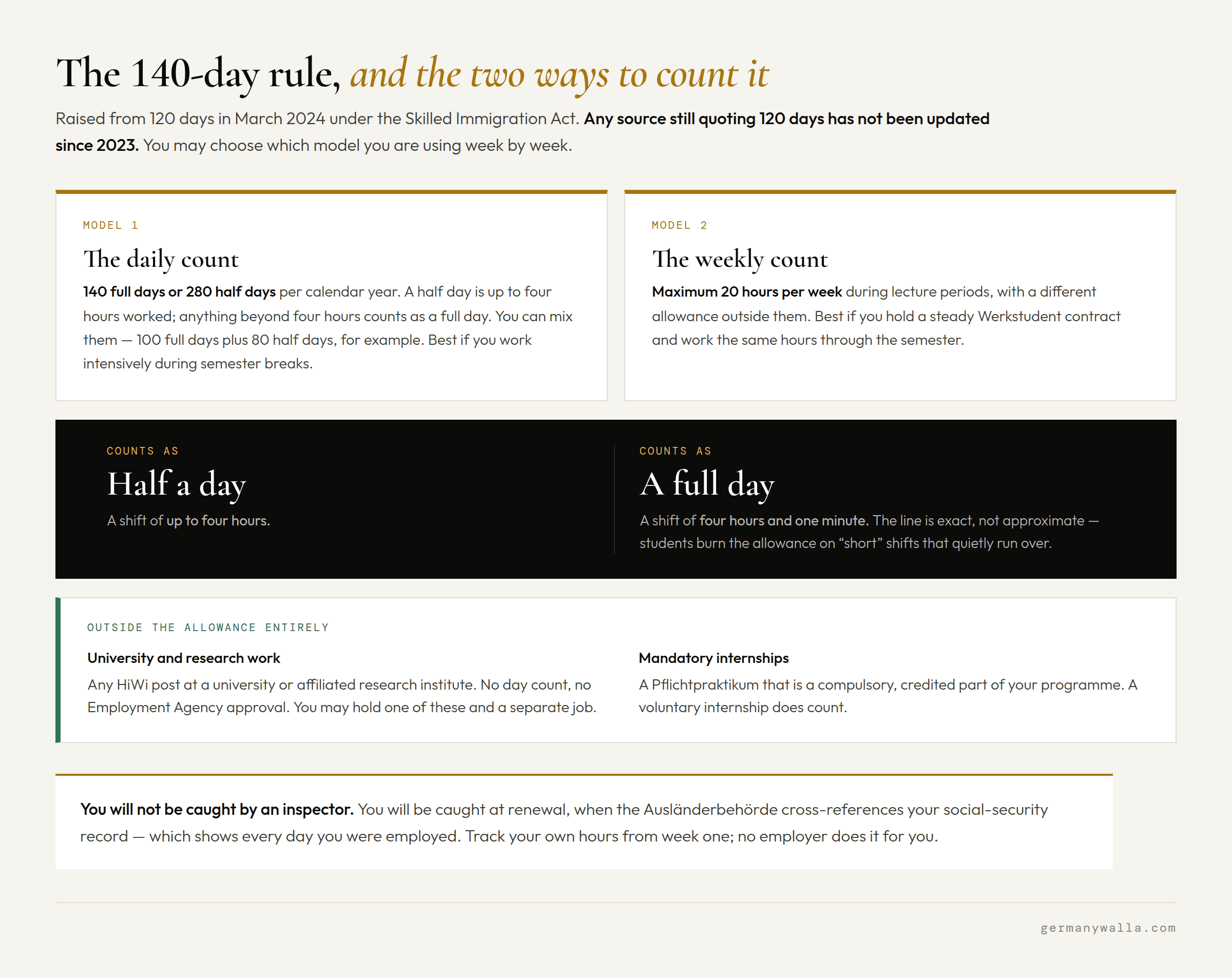
⚠️ The four-hour line is unforgiving. A shift of four hours counts as half a day. A shift of four hours and fifteen minutes counts as a full day. Students burn through their allowance without realising it by taking "short" shifts that quietly run over. Track your own hours in a spreadsheet from week one — your employer will not do it for you, and the Ausländerbehörde will not accept "I lost count" as an explanation.
The Two Exemptions Worth Building Your Plan Around
Two categories of work sit entirely outside the 140-day allowance, and they are the most valuable thing in this whole article:
- University and research-institution jobs — the studentische Hilfskraft or HiWi role. Work at your own university, another university, or an affiliated research institute does not count against the day limit and needs no Employment Agency approval. You can hold one of these and a separate job elsewhere.
- Mandatory internships — a Pflichtpraktikum that is a compulsory, credited part of your study programme does not consume your days either. A voluntary internship (freiwilliges Praktikum) does.
This exemption is the single most under-exploited rule in the German student system. A HiWi job at your own institute pays €12–17 an hour, looks excellent on a CV for a German thesis or a later Werkstudent application, and costs you zero days from your allowance. Students spend months chasing restaurant shifts that eat their 140 days while the department two floors up has an unfilled HiWi post advertised on a paper notice board. Walk into your department office in week one of the semester and ask. That is genuinely how most of these are filled.
What Happens If You Work More Than 140 Days
Be clear-eyed about this one. Exceeding your work allowance is a breach of the conditions of your residence permit and is treated as illegal employment. Consequences range from a formal warning through fines to non-renewal of your permit and, at the serious end, expulsion and a re-entry ban. Employers who knowingly participate face their own penalties, which is why reputable German employers ask to see your permit and track your days themselves.
You will not be caught by a random inspector. You will be caught when you apply to extend your residence permit and the Ausländerbehörde cross-references your social-security record — which shows every day you were employed.
Part-Time Job Salary in Germany: What You Actually Earn
Germany has a statutory national minimum wage (Mindestlohn) that applies to students exactly as it applies to everyone else. There is no student rate and no international-student rate. If an employer offers you less, that offer is illegal.
| Period | Statutory Minimum Wage | Minijob Monthly Ceiling |
|---|---|---|
| 2025 | €12.82 / hour | €556 / month |
| From 1 Jan 2026 | €13.90 / hour | €603 / month |
| From 1 Jan 2027 | €14.60 / hour | Rises with the wage (expected ≈ €633) |
* The Minijob ceiling is pegged to the minimum wage by formula, so it moves automatically each time the wage rises. Confirm the exact 2027 figure closer to the date.
Monthly Earnings by Working Pattern (2026 Rates)
The number students actually want is monthly, not hourly. A month contains roughly 4.33 weeks, so 20 hours a week is about 86.6 hours a month. Here is what that produces at different rates:
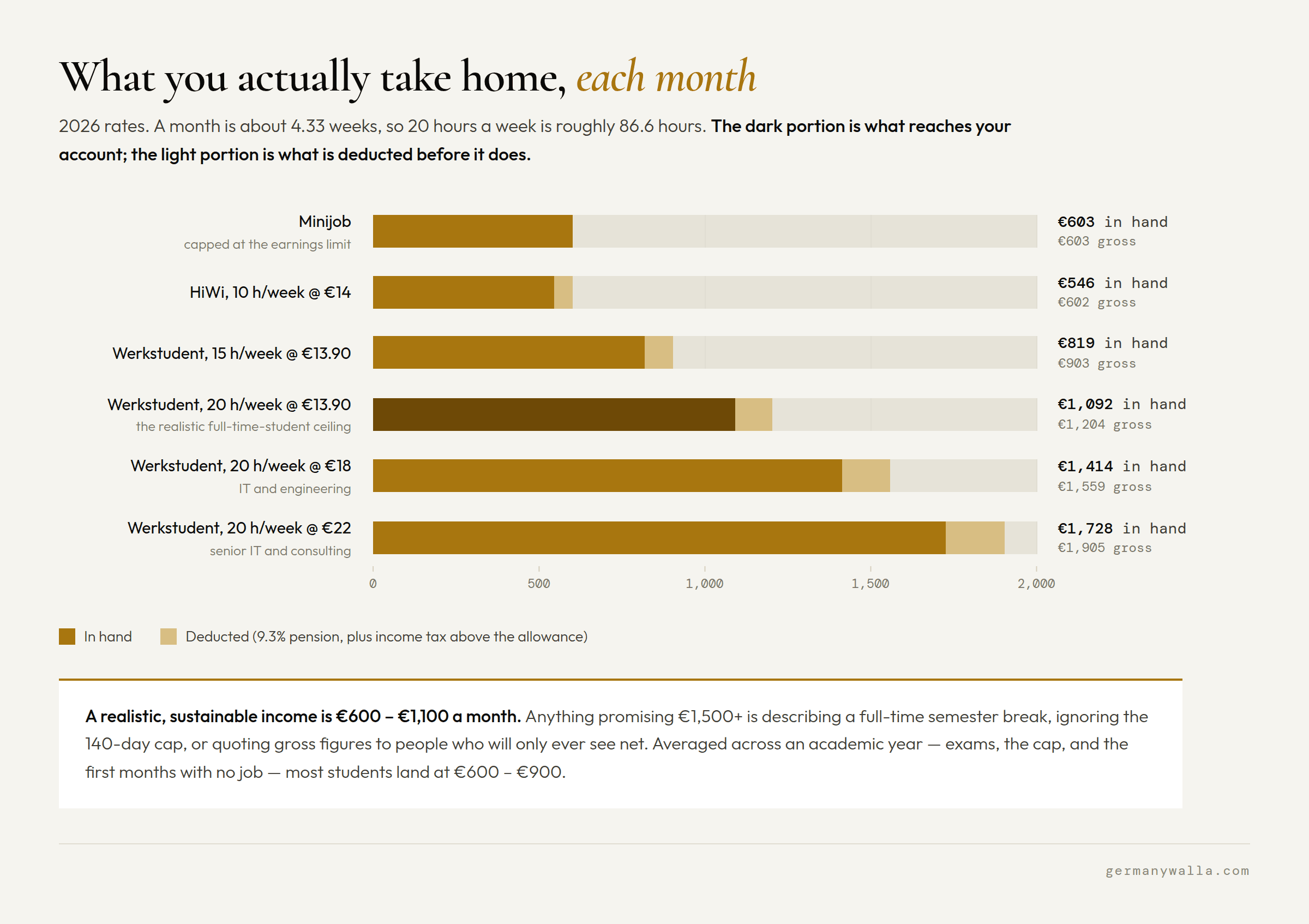
| Pattern | Hours / Month | Gross / Month | Roughly In Hand |
|---|---|---|---|
| Minijob (capped) | ~43 | €603 | €603 — tax-free, no employee contributions |
| HiWi, 10 h/week @ €14 | 43 | €602 | ≈ €546 after pension |
| Werkstudent, 15 h/week @ €13.90 | 65 | €903 | ≈ €819 |
| Werkstudent, 20 h/week @ €13.90 | 86.6 | €1,204 | ≈ €1,092 |
| Werkstudent, 20 h/week @ €18 (IT / engineering) | 86.6 | €1,559 | ≈ €1,414 before income tax |
| Werkstudent, 20 h/week @ €22 (senior IT / consulting) | 86.6 | €1,905 | ≈ €1,728 before income tax |
* "Roughly in hand" deducts the 9.3% employee pension contribution that applies to Werkstudent and HiWi roles. Income tax is deducted monthly above the tax-free allowance and is largely refundable — see the tax section.
A realistic, sustainable part-time income for an Indian student in Germany in 2026 is €600–€1,100 per month. The bottom of that range is a Minijob or a light HiWi post. The top is a 20-hour Werkstudent contract in a technical field. Anything you read promising €1,500+ a month is either describing a full-time semester break, ignoring the 140-day cap, or quoting gross figures at people who will only ever see net.
The Four Contract Types: Minijob, Werkstudent, HiWi and Regular Part-Time
Indian students routinely take the first job offered without understanding which of these four they have signed. The choice changes your tax, your health insurance, your pension deductions and whether the work counts against your 140 days. Get it wrong and it costs real money every single month.
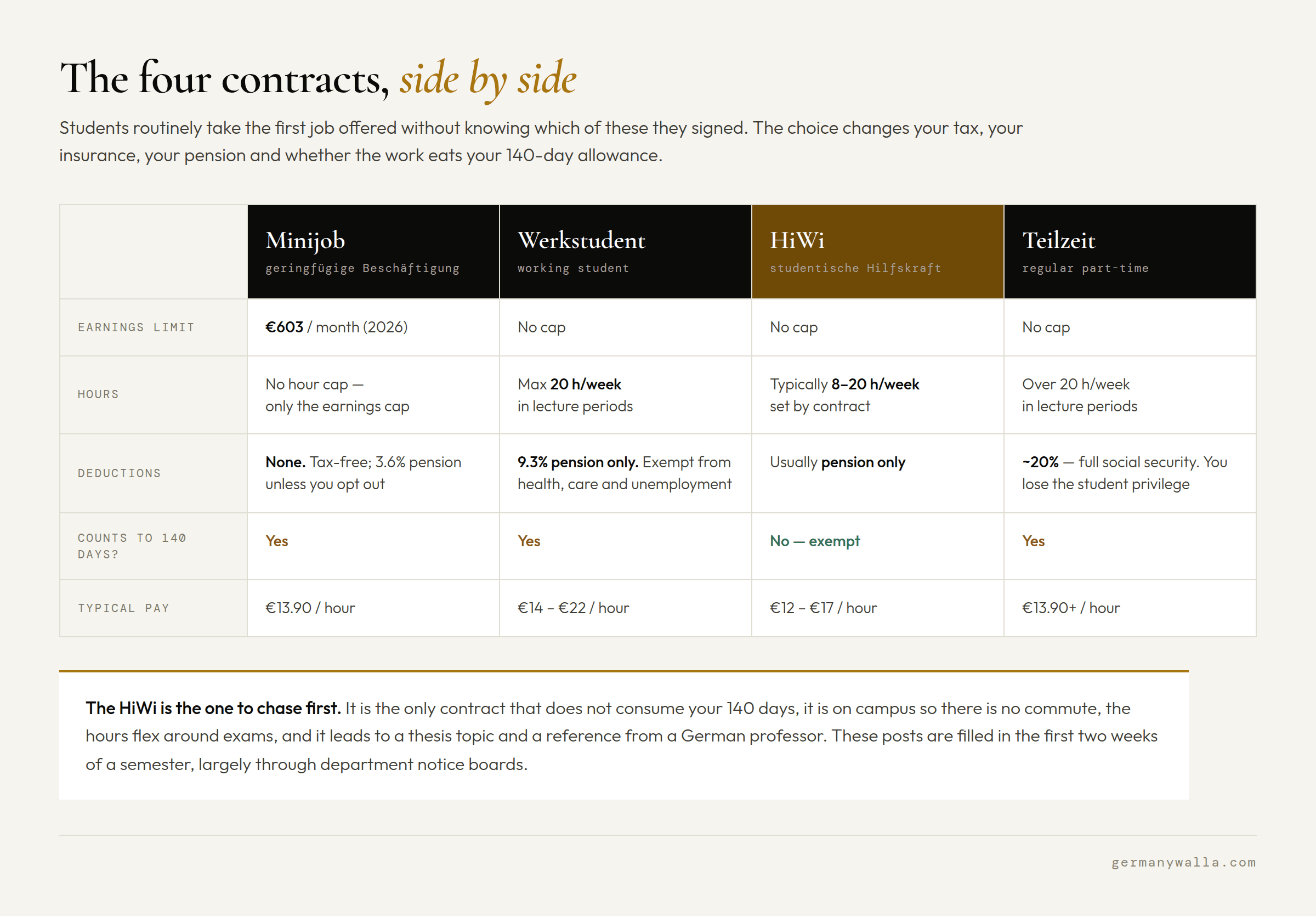
| Type | Earnings Limit | Hours | Deductions | Counts to 140 Days? |
|---|---|---|---|---|
| Minijob geringfügige Beschäftigung | €603 / month (2026) | No hour cap — only the earnings cap | None for you. Tax-free; 3.6% pension unless you opt out | Yes |
| Werkstudent working student | No cap | Max 20 h/week during lecture periods | 9.3% pension only. Exempt from health, care and unemployment insurance | Yes |
| HiWi studentische Hilfskraft | No cap | Typically 8–20 h/week, set by contract | Usually pension only | No — exempt |
| Regular part-time Teilzeit | No cap | Over 20 h/week in lecture periods | ~20% — full social security, you lose the student privilege | Yes |
Minijob — Simple, Capped, Tax-Free
The Minijob is the entry point for most students. You may earn up to €603 a month in 2026 and the entire amount is free of income tax and of employee social-security contributions. Your employer pays a flat levy; you keep the gross. There is no limit on how many hours you work, only on what you earn — so at €13.90 an hour the ceiling works out to roughly 43 hours a month.
The one deduction is a 3.6% pension contribution, and you can file a short form to opt out of it. Most students do. The trap: exceeding €603 in a month does not just cost you the excess — it can reclassify the whole job and pull you into full social-security territory retroactively. Watch the cap every month, especially in months where you pick up extra shifts.
Werkstudent — The Job That Pays and Builds a Career
A Werkstudent contract is a part-time role at a company, related to your field of study, held while you are enrolled. It is the most valuable category on this list because it does three things at once: it pays the most (€14–22 an hour is normal, and technical roles go higher), it carries the Werkstudentenprivileg, and it is the single most reliable route to a full-time offer after graduation. A very large share of German graduate hiring happens through converted Werkstudent contracts.
The Werkstudent privilege means you are exempt from health insurance, long-term care insurance and unemployment insurance contributions. You pay only 9.3% pension, with your employer matching it. Against a normal employee's roughly 20% employee share, that is a large difference on the same gross salary.
The condition is the 20-hour rule during lecture periods. There are recognised exceptions — work during semester breaks, and work in evenings after 6pm or at weekends — provided you do not exceed 20 hours a week for more than 26 weeks (182 days) in a year. Break the rule persistently and you lose the privilege, and the insurers can back-bill you for contributions you never budgeted for.
HiWi — The Exempt One, and the Most Overlooked
A studentische Hilfskraft (student assistant, universally shortened to HiWi) works for a professor, a chair, a lab, a library or a research institute. Typical work is assisting with research, marking, running tutorials, lab support, data work or library duty. Pay commonly runs €12–17 an hour depending on the state and whether you already hold a Bachelor's.
The pay is not the point. The point is that this work does not count against your 140 days, it is on campus so there is no commute, the hours flex around your exams because your supervisor is an academic, and it opens the door to a thesis topic and a reference letter from a German professor. If you can get one, take it before anything else.
Regular Part-Time — Usually the Wrong Answer
If you work more than 20 hours a week during lecture periods on an ordinary contract, you are legally an employee who happens to be studying rather than a student who works. Full social-security contributions apply, roughly doubling your deductions, and you will still be inside the 140-day cap. There are narrow cases where this makes sense. For most students it does not.
German Language Requirement for Part-Time Jobs: Why B1 and B2 Change Everything
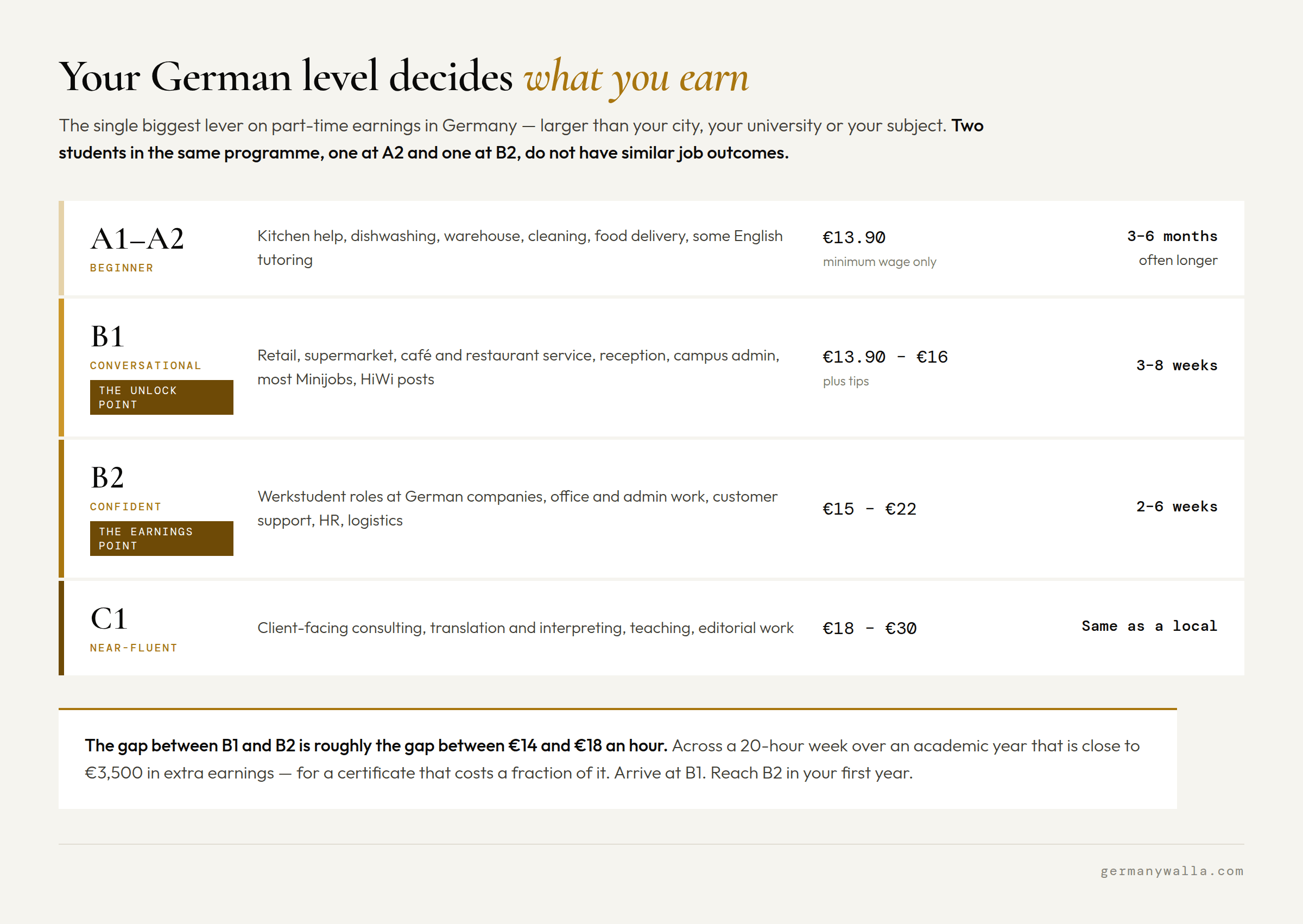
If you take one thing from this guide, take this. Your German level is the single biggest lever on your part-time earnings in Germany — larger than your city, larger than your university, larger than your field of study. Two Indian students in the same Master's programme in the same city, one at A2 and one at B2, will not have similar job outcomes. They will have completely different ones.
The reason is simple and structural. Germany's part-time job market runs in German. Job adverts are written in German. Interviews are in German. Shift instructions, safety briefings, customer conversations and internal tools are in German. English-only roles exist, but they are a narrow slice of a very large market — and every international student in the country is competing for that same slice.
| German Level | What Opens Up | Typical Pay | Realistic Job Search |
|---|---|---|---|
| A1 – A2 | Kitchen help, dishwashing, warehouse, cleaning, food delivery, some English-language tutoring, English-speaking IT HiWi if you are lucky | €13.90 (minimum only) | 3–6 months, often longer |
| B1 | The unlock point. Retail, supermarket, café and restaurant service, shelf-stocking, reception, campus admin, most Minijobs, university HiWi posts | €13.90 – €16 + tips | 3–8 weeks |
| B2 | The earnings point. Werkstudent roles at German companies, office and admin work, customer support, banking and insurance back-office, HR, logistics coordination | €15 – €22 | 2–6 weeks |
| C1 | Client-facing consulting, translation and interpreting, teaching, editorial work, and essentially the same market a German student competes in | €18 – €30 | Comparable to a local |
Why B1 Is the Minimum You Should Target Before You Land
At A2 you can technically survive — but you are restricted to the physically hardest, lowest-paid, least flexible work, and you are applying against every other newly arrived international student for the same handful of English-tolerant positions. Search times of four to six months are normal, which means burning through your blocked account during exactly the period when you have no income.
B1 is where the market opens. At B1 you can take an order, handle a till, understand a shift instruction, answer a customer, and pass a short informal interview. That is the entire requirement for the majority of student jobs in Germany. Employers advertising retail and hospitality roles routinely write "gute Deutschkenntnisse" — good German — and B1 is what they mean.
Why B2 Is What You Should Actually Be Aiming For
B2 is where the money is. Werkstudent postings at German companies — the roles paying €16–22 an hour, the ones that convert into graduate jobs — are overwhelmingly written in German and list "sehr gute Deutschkenntnisse" or "verhandlungssicheres Deutsch" among the requirements. Without B2, you are not filtered out at interview. You are filtered out before a human reads your application.
The gap between B1 and B2 is roughly the gap between €14 an hour and €18 an hour. Over a 20-hour week across an academic year, that is somewhere near €3,500 in additional earnings — for a language certificate that costs a fraction of that to obtain.
The mistake I see most often is treating German as something to start after arriving. It is exactly backwards. Six months of serious German in India, reaching B1 before you board the flight, is worth more to your finances than any other single preparation you can make. It is the difference between earning from your second month and earning from your sixth — and in a first year where your blocked account releases only €992 a month, four months of income is not a rounding error. Arrive at B1. Reach B2 in your first year. Everything else about working in Germany gets easier from there.
Which Jobs Genuinely Do Not Need German
They exist, and it is worth knowing them precisely rather than hoping:
- IT and software Werkstudent roles at international companies and startups — strongest in Berlin, Munich and Hamburg, where the working language is often English
- Research HiWi posts in English-taught Master's programmes, especially in engineering, data science and the natural sciences
- Tutoring in mathematics, physics, programming or English
- Food delivery — the app is the interface, not a conversation
- Warehouse and logistics night shifts, where instructions are visual and repetitive
Notice what that list has in common: except for the first two, these are the lowest-paid and least career-relevant options available. English-only work is a bridge, not a destination.
Not sure whether your German plan is realistic?
Language timeline, semester dates, application deadlines and your funding plan have to line up. We build that sequence with you on a Clarity Call — including how much German you actually need before you land.
Types of Part-Time Jobs in Germany: What Indian Students Actually Do
These are the roles Indian students realistically hold, with 2026 pay ranges and the German level each one genuinely requires. Rates vary by city and employer — Munich and Frankfurt pay above these, smaller eastern cities below.
| Job | Typical Pay / Hour | German Needed | Notes |
|---|---|---|---|
| HiWi / research assistant | €12 – €17 | Often English OK | Exempt from the 140-day cap |
| Werkstudent — IT / software | €16 – €25 | English often OK | Highest-paying realistic option |
| Werkstudent — engineering / business | €14 – €22 | B2 usually required | Converts into graduate roles |
| Tutoring (maths, physics, coding, English) | €15 – €25 | Not required | Flexible; hard to fill many hours |
| Restaurant / café / bar service | €13.90 – €16 + tips | B1 | Evening and weekend hours suit lectures |
| Retail / supermarket | €13.90 – €15 | B1 | Reliable, structured shifts |
| Warehouse / logistics | €13.90 – €16 | A2 sufficient | Physically demanding; night shifts pay more |
| Food delivery (Lieferando, Wolt) | €13.90 – €15 + tips | Not required | Weather-dependent; own bike often needed |
| Call centre / customer support | €14 – €18 | B2 for German lines | English lines exist at international firms |
| Campus library / admin | €13.90 – €15 | Often English OK | Quiet shifts; you can often study |
| Babysitting / pet sitting | €12 – €16 | A2 – B1 | Usually informal; insist on a contract |
| Translation / interpreting | €18 – €30 | C1 | Hindi/Punjabi/Tamil ↔ German is a real niche |
⚠️ Freelancing and self-employment are not included on this list for a reason. Indian students on a §16b permit are generally not permitted to be self-employed or work freelance without separate approval from the Ausländerbehörde. That includes Upwork, Fiverr, freelance coding, running an online shop and paid content creation. Taking freelance income without permission is a permit violation — get written approval first or do not do it.
Where to Find Part-Time Jobs in Germany
Ranked by what actually works for a newly arrived Indian student, rather than by how well known the platform is:
- Your university's job board and department notice boards. The Schwarzes Brett — literally the black board — is still where HiWi posts are advertised, often on paper. Check your faculty building physically, not just online.
- Your own professors and chairs. Email the chair of a subject you did well in and ask directly whether they need a HiWi. This fills more positions than any portal.
- Studentenwerk job portals. Every university city's student services organisation runs a jobs board aimed specifically at students, with employers who already understand student contracts.
- Jobmensa and Studentjob. Student-specific platforms; good for Minijobs and short-term work.
- Indeed.de and StepStone.de — filter by the German keywords Werkstudent, Minijob, Studentenjob and Aushilfe. Searching in English hides most of the market from you.
- LinkedIn and Xing. LinkedIn for international companies; Xing still matters at German Mittelstand firms.
- Company career pages directly. Large German employers post Werkstudent roles on their own sites and often nowhere else.
- The Bundesagentur für Arbeit job portal. The federal employment agency's board — free, official, enormous.
- Walking in. Unfashionable and genuinely effective for cafés, restaurants and small retailers. Print ten CVs, go on a weekday afternoon between lunch and dinner service, and ask for the manager.
- Indian and student community groups. City-specific WhatsApp and Facebook groups surface openings early — but verify the employer and insist on a written contract.
HiWi positions are filled in the first two weeks of a semester and almost never after. Werkstudent roles run on a four-to-eight-week hiring cycle, so apply well before you need the income. Hospitality and retail hire hardest before Christmas and before the summer season. Arriving in October and starting your search in December means missing every one of those windows.
How to Apply: The German Application Process
German applications follow a specific format, and Indian students lose good jobs by submitting an Indian-style CV. The conventions are rigid enough that ignoring them reads as carelessness.
Documents You Need Before You Can Legally Start Work
You cannot simply be hired and begin. German payroll requires several numbers that take weeks to arrive, and the sequence matters — each one depends on the previous one. Start this on your first week in Germany, not when you get a job offer.
| Document | Where It Comes From | Typical Wait |
|---|---|---|
| City registration Anmeldung | Local Bürgeramt — book the appointment before you fly | 1–6 weeks for an appointment |
| Tax ID Steueridentifikationsnummer | Arrives by post automatically after Anmeldung | 2–6 weeks |
| German bank account | Any German bank or neobank | Days |
| Health insurance certificate | Your public insurer — TK, AOK, Barmer and others | 1–2 weeks |
| Social security number Sozialversicherungsnummer | Issued via your health insurer | 2–6 weeks |
| Residence permit Aufenthaltstitel | Ausländerbehörde — the card replaces your entry visa | 4–12 weeks |
| Health certificate Gesundheitsbelehrung | Local health office — required for any food-handling job | Days; small fee |
| Enrolment certificate Immatrikulationsbescheinigung | Your university portal | Immediate |
⚠️ This is the real reason students do not earn in their first two months. It is rarely that no jobs exist — it is that the tax ID has not arrived, so payroll cannot be set up. Book your Anmeldung appointment before you leave India if your city allows online booking, and treat it as the first thing you do after finding accommodation. Everything else queues behind it.
Tax and Social Security: What Gets Deducted and How to Get It Back
Germany's basic tax-free allowance (Grundfreibetrag) is €12,348 for 2026, up from €12,096 in 2025. Below that annual income you owe no income tax at all — and if tax was deducted from your monthly payslips anyway, you get it back by filing a return.
Notice how this interacts with the earlier table. A 20-hour Werkstudent week at minimum wage produces €1,204 gross a month — above the monthly threshold, but only marginally, and only if you sustain it for all twelve months. Most students do not, because exam periods and the 140-day cap interrupt it. In practice a large share of Indian students end the year below €12,348 and are entitled to a refund of everything withheld.
What Comes Out of Your Payslip
- Minijob: nothing, other than an optional 3.6% pension you can opt out of. €603 gross is €603 net.
- Werkstudent and HiWi: 9.3% pension, plus income tax only on earnings above the allowance. No health, care or unemployment contributions — that is the Werkstudentenprivileg.
- Regular part-time over 20 hours: the full employee share, roughly 20%. This is what you are avoiding by keeping Werkstudent status.
- Second job: a second employment is taxed under tax class VI, which withholds aggressively. It is usually recovered through your annual return, but expect a thin second payslip.
File a German tax return every year, even when you are certain you owe nothing. A student who earned under the allowance and had tax withheld typically receives several hundred euros back — sometimes over a thousand. You can file for previous years retroactively, so a return filed in your final year can recover money from your first. Free and low-cost filing tools handle a simple student return in under an hour, and the pension contributions you paid are refundable in certain circumstances if you later leave Germany permanently. This is the easiest money in this entire article and most students never claim it.
What to Keep in Mind: 12 Rules for Working Part-Time in Germany
- Track your days from day one. Nobody else is counting them for you, and the Ausländerbehörde will check your social-security record at renewal.
- Four hours and one minute is a full day. The half-day rule is exact, not approximate.
- Take the HiWi job first. It is exempt from the cap, it is on campus, and it builds the academic relationship that leads to a thesis and a reference.
- Never freelance without written permission. Upwork, Fiverr, freelance development and paid content all count as self-employment for permit purposes.
- Watch the €603 Minijob ceiling monthly. One heavy month can reclassify the job and trigger contributions you did not budget for.
- Protect your Werkstudent status. Persistently exceeding 20 hours in lecture periods can cost you the privilege and produce a back-dated insurance bill.
- Reach B1 before you land, B2 within your first year. It is the highest-return preparation you can do, financially and professionally.
- Get everything in writing. A written Arbeitsvertrag and a signed timesheet protect you if a dispute arises.
- Refuse cash in hand. Undeclared work is illegal for the employer and a permit violation for you.
- Your studies come first, legally as well as practically. Your permit exists for study. Failing modules or exceeding standard study duration puts renewal at risk far faster than any job ever will.
- File your tax return. Every year, even a year you are sure was below the threshold.
- Do not plan your finances around a job you do not have yet. Assume no income for your first three months and build the budget from there.
Can a Part-Time Job Fund Your Studies in Germany? The Honest Maths
This is the question underneath every other question on this page, and it deserves a straight answer rather than a marketing one.
Your blocked account releases €992 per month — the figure the German government considers a realistic student living cost, and the basis of the €11,904 you deposit for a visa. Actual living costs across German cities run roughly €850 to €1,200 a month, with rent as the dominant variable.
Do the arithmetic properly. A 20-hour Werkstudent week at minimum wage is about €1,092 in hand. Sustained across twelve months that is genuinely enough to live on in most German cities. But you will not sustain it across twelve months — the 140-day cap, exam weeks, thesis deadlines and the two or three months at the start with no job at all all bite into it. A realistic annual average, across a normal academic year, is €600 to €900 a month.
That number covers most of your living costs and none of your emergencies. It is a strong supplement and a weak foundation. Plan on the blocked account plus family support as your foundation, and treat part-time income as what makes the difference between surviving in Germany and living there comfortably.
For the full city-by-city cost picture, read our cost of living in Germany for Indian students breakdown — and for what is genuinely free and what is not, see free education in Germany.
Frequently Asked Questions — Part-Time Jobs in Germany for Indian Students
Working part-time in Germany is one of the genuine advantages of the country over most study destinations. The wage is real, the rules are clear, and the Werkstudent route turns a student job into a graduate career in a way that almost nowhere else does.
But it rewards sequence. German before arrival, paperwork before job hunting, HiWi before hospitality, contract before first shift, tax return before you leave. Get the order right and the money follows. Get it wrong and you will spend your first year doing minimum-wage shifts that eat the allowance you needed for something better.